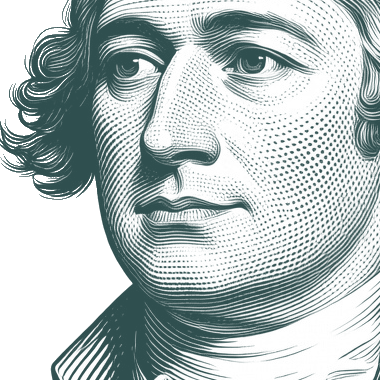
There are seasons in every country when noise and impudence pass current for worth; and in popular commotions especially, the clamors of interested a… - Alexander Hamilton
""
There are seasons in every country when noise and impudence pass current for worth; and in popular commotions especially, the clamors of interested and factious men are often mistaken for patriotism.
Alexander Hamilton (11 January 1755 or 1757 – 12 July 1804) was a Founding Father of the United States, chief staff aide to General George Washington, one of the most influential interpreters and promoters of the U.S. Constitution, the founder of the nation's financial system, the founder of the Federalist Party, the world's first voter-based political party, the Father of the United States Coast Guard, and the founder of The New York Post.
Biography information from
Wikiquote·
Portrait adapted from
Wikimedia Commons, John Trumbull (Public domain / CC0)
Also Known As
Pen Names:
Publius
Alternative Names:
Hamilton
•
Alexander Hamilton, US Treasury secretary
•
A. Ham
Justice is the end of government. It is the end of civil society. It ever has been, and ever will be, pursued, until it be obtained, or until liberty be lost in the pursuit. In a society, under the forms of which the stronger faction can readily unite and oppress the weaker, anarchy may as truly be said to reign, as in a state of nature where the weaker individual is not secured against the violence of the stronger: And as in the latter state even the stronger individuals are prompted by the uncertainty of their condition, to submit to a government which may protect the weak, as well as themselves: so in the former state, will the more powerful factions be gradually induced by a like motive, to wish for a government which will protect all parties, the weaker as well as the more powerful.
The expediency of encouraging manufactures in the United States, which was not long since deemed very questionable, appears at this time to be pretty generally admitted. (...) There still are, nevertheless, respectable patrons of opinions, unfriendly to the encouragement of manufactures. The following are, substantially, the arguments, by which these opinions are defended. (...) “In every country (say those who entertain them,) Agriculture is the most beneficial and productive object of human industry. (...) To endeavor by the extraordinary patronage of Government, to accelerate the growth of manufactures, is in fact, to endeavor, by force and art, to transfer the natural current of industry, from a more, to a less beneficial channel. Whatever has such a tendency must necessarily be unwise. Indeed it can hardly ever be wise in a government, to attempt to give a direction to the industry of its citizens. This under the quick-sighted guidance of private interest, will, if left to itself, infallibly find its own way to the most profitable employment; and it is by such employment, that the public prosperity will be most effectually promoted. To leave industry to itself, therefore, is, in almost every case, the soundest as well as the simplest policy.” This policy is not only recommended to the United States, by considerations which affect all nations, it is, in a manner, dictated to them by the imperious force of a very peculiar situation.
Enhance Your Quote Experience
Enjoy ad-free browsing, unlimited collections, and advanced search features with Premium.