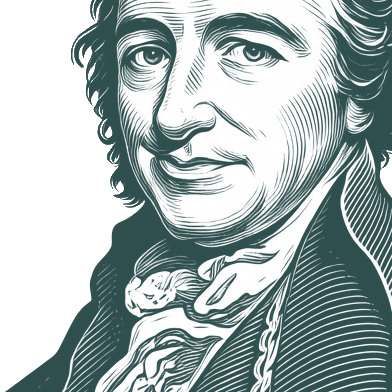
Perhaps the sentiments contained in the following pages, are not YET sufficiently fashionable to procure them general favour; a long habit of not thi… - Thomas Paine
""
Perhaps the sentiments contained in the following pages, are not YET sufficiently fashionable to procure them general favour; a long habit of not thinking a thing WRONG, gives it a superficial appearance of being RIGHT, and raises at first a formidable outcry in defense of custom. But the tumult soon subsides. Time makes more converts than reason.
English
Collect this quote
About
Thomas Paine
Thomas Paine (February 9, 1737 [O.S. January 29, 1736] – 8 June 1809) was a British-American political writer, theorist, and activist who had a great influence on the thoughts and ideas which led to the American Revolution and the United States Declaration of Independence. He wrote three of the most influential and controversial works of the 18th Century: Common Sense, Rights of Man, and The Age of Reason. His ideas reflected Enlightenment-era ideals of transnational human rights.
Biography information from
Wikiquote·
Portrait adapted from
Wikimedia Commons, Auguste Millière / After George Romney / After William Sharp (Public domain / CC0)
Portrait from Wikimedia Commons. Credit: Auguste Millière / After George Romney / After William Sharp. Used under Public domain / CC0. Processed and styled by Quotewise.
Go Premium
Support Quotewise while enjoying an ad-free experience and premium features.
Superstition and hallucination are really one thing, and fanaticism, which is mental obsession, easily becomes acute and the whirling dervish runs amuck at sight of a man whose religious opinions are different from his own.
There is not, throughout the whole book called the Bible, any word that describes to us what we call a poet, nor any word that describes what we call poetry. The case is, that the word prophet, to which later times have affixed a new idea, was the Bible word for poet, and the word prophesying meant the art of making poetry. It also meant the art of playing poetry to a tune upon any instrument of music. We read of prophesying with pipes, tabrets, and horns — of prophesying with harps, with psalteries, with cymbals, and with every other instrument of music then in fashion.9 Were we now to speak of prophesying with a fiddle, or with a pipe and tabor, the expression would have no meaning, or would appear ridiculous, and to some people contemptuous, because we have changed the meaning of the word.
The most detestable wickedness, the most horrid cruelties, and the greatest miseries that have afflicted the human race, have had their origin in this thing called revelation, or revealed religion. It has been the most dishonorable belief against the character of the divinity, the most destructive to morality and the peace and happiness of man, that ever was propagated since man began to exist. It is better, far better, that we admitted, if it were possible, a thousand devils to roam at large, and to preach publicly the doctrine of devils, if there were any such, than that we permitted one such impostor and monster as Moses, Joshua, Samuel, and the bible prophets, to come with the pretended word of God in his mouth, and have credit among us.