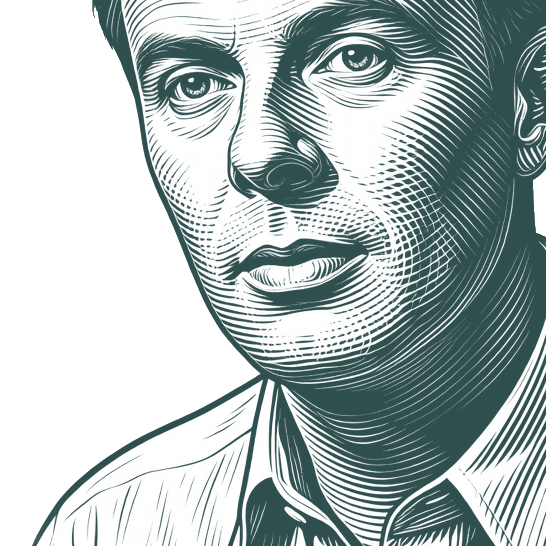
It is better that one should suffer than that many should be corrupted. Consider the matter dispassionately, Mr. Foster, and you will see that no off… - Aldous Huxley
""
It is better that one should suffer than that many should be corrupted. Consider the matter dispassionately, Mr. Foster, and you will see that no offence so heinous as unorthodoxy of behaviour. Murder kills only the individual — and after all what is an individual? With a sweeping gesture he indicated the rows of microscopes, the test-tubes, the incubators. We can make a new one with the greatest ease — As many as we like. Unorthodoxy threatens more than the lie of a mere individual; it strikes at Society itself, he repeated.
English
Collect this quote
About
Aldous Huxley
Aldous Leonard Huxley (26 July 1894 – 22 November 1963) was a British author known for his novel Brave New World. He was the grandson of Thomas Henry Huxley and younger brother of Julian Huxley.
"But, Bernard, you're saying the most awful things.'
'Don't you wish you were free, Lenina?'
'I don't know what you mean. I am free. Free to have the most wonderful time. Everybody's happy nowadays.'
He laughed, 'Yes, "Everybody's happy nowadays." We begin giving children that at five. But wouldn't you like to be free to e happy in some other way, Lenina? In your own way, for example; not in everybody else's way."
Bernard gave his orders in the sharp, rather arrogant and even offensive tone of one who does not feel himself too secure in his superiority.
"In regard to propaganda the early advocates of universal literacy and a free press envisaged only two possibilities: the propaganda might be true, or the propaganda might be false. They did not foresee what in fact has happened, above all in our Western capitalist democracies - the development of a vast mass communications industry, concerned in the main neither with the true nor the false, but with the unreal, the more or less totally irrelevant. In a word, they failed to take into account man's almost infinite appetite for distractions. In the past most people never got a chance of fully satisfying this appetite. They might long for distractions, but the distractions were not provided. Christmas came but once a year, feasts were "solemn and rare," there were few readers and very little to read, and the nearest approach to a neighborhood movie theater was the parish church, where the performances though frequent, were somewhat monotonous. For conditions even remotely comparable to those now prevailing we must return to imperial Rome, where the populace was kept in good humor by frequent, gratuitous doses of many kinds of entertainment - from poetical dramas to gladiatorial fights, from recitations of Virgil to all-out boxing, from concerts to military reviews and public executions. But even in Rome there was nothing like the non-stop distractions now provided by newspapers and magazines, by radio, television and the cinema. In "Brave New World" non-stop distractions of the most fascinating nature are deliberately used as instruments of policy, for the purpose of preventing people from paying too much attention to the realities of the social and political situation. The other world of religion is different from the other world of entertainment; but they resemble one another in being most decidedly "not of this world." Both are distractions and, if lived in too continuously, both can become, in Marx's phrase "the opium of the people" and so a threat to freedom.