And now let any Union man who complains of the measure, test himself by writing down in one line that he is for subduing the rebellion by force of ar… - Abraham Lincoln
""
And now let any Union man who complains of the measure, test himself by writing down in one line that he is for subduing the rebellion by force of arms; and in the next, that he is for taking these hundred and thirty thousand men from the Union side, and placing them where they would be but for the measure he condemns. If he can not face his case so stated, it is only because he can not face the truth.
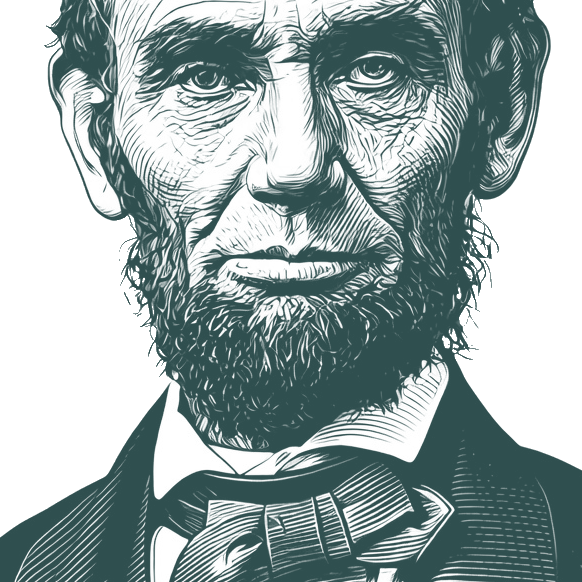
Abraham Lincoln (12 February 1809 – 15 April 1865) was the 16th president of the United States, serving from March 1861 until his assassination in April 1865. Initially entering politics as a Whig, he became a member of the US congress from Illinois, and later the first Republican president, leading Union forces throughout the moral, constitutional, political and military crises of the American Civil War, during which he abolished slavery and strengthened the U.S. government.
Biography information from
Wikiquote·
Portrait adapted from
Wikimedia Commons, Alexander Gardner (Public domain / CC0)
Also Known As
Alternative Names:
Honest Abe
•
President Lincoln
•
Abe Lincoln
•
Uncle Abe
•
A. Lincoln
•
Lincoln
The several points of the Dred Scott decision, in connection with Senator Douglas's "care-not" policy, constitute the piece of machinery, in its present state of advancement. This was the third point gained. The working points of that machinery are: (1) That no negro slave, imported as such from Africa, and no descendant of such slave, can ever be a citizen of any State, in the sense of that term as used in the Constitution of the United States. This point is made in order to deprive the negro in every possible event of the benefit of that provision of the United States Constitution which declares that "the citizens of each State shall be entitled to all the privileges and immunities of citizens in the several States." (2) That, "subject to the Constitution of the United States," neither Congress nor a territorial legislature can exclude slavery from any United States Territory. This point is made in order that individual men may fill up the Territories with slaves, without danger of losing them as property, and thus enhance the chances of permanency to the institution through all the future. (3) That whether the holding a negro in actual slavery in a free State makes him free as against the holder, the United States courts will not decide, but will leave to be decided by the courts of any slave State the negro may be forced into by the master. This point is made not to be pressed immediately, but, if acquiesced in for a while, and apparently indorsed by the people at an election, then to sustain the logical conclusion that what Dred Scott's master might lawfully do with Dred Scott in the free State of Illinois, every other master may lawfully do with any other one or one thousand slaves in Illinois or in any other free State.
I care not for a man's religion whose dog and cat are not the better for it.
Enhance Your Quote Experience
Enjoy ad-free browsing, unlimited collections, and advanced search features with Premium.
I do not remember that you and I ever met personally. I write this now as a grateful acknowledgment for the almost inestimable service you have done the country. I wish to say a word further. When you first reached the vicinity of Vicksburg, I thought you should do, what you finally did, march the troops across the neck, run the batteries with the transports, and thus go below; and I never had any faith, except a general hope that you knew better than I, that the Yazoo Pass expedition, and the like, could succeed. When you got below, and took Port-Gibson, Grand Gulf, and vicinity, I thought you should go down the river and join General Banks; and when you turned Northward East of the Big Black, I feared it was a mistake. I now wish to make the personal acknowledgment that you were right, and I was wrong.