The Earth is the only world known so far to harbour life. There is nowhere else, at least in the near future, to which our species could migrate. Vis… - Carl Sagan
""
The Earth is the only world known so far to harbour life. There is nowhere else, at least in the near future, to which our species could migrate. Visit? Yes. Settle? Not yet. Like it or not, for the moment, the Earth is where we make our stand. It has been said that astronomy is a humbling and character-building experience. ... To me, it underscores our responsibility to deal more kindly with one another and to preserve, and cherish, the pale blue dot; the only home we've ever known.
English
Collect this quote
About
Carl Sagan
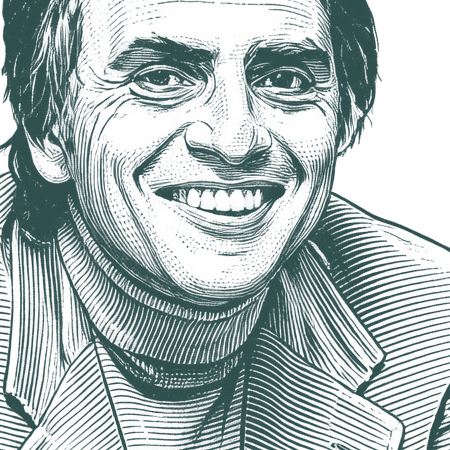
Carl Edward Sagan (9 November 1934 – 20 December 1996) was an American astronomer, planetary scientist, cosmologist, astrophysicist, astrobiologist, author, and science communicator. His best known scientific contribution is research on extraterrestrial life, including experimental demonstration of the production of amino acids from basic chemicals by radiation. Sagan assembled the first physical messages sent into space, the Pioneer plaque and the Voyager Golden Record, universal messages that could potentially be understood by any extraterrestrial intelligence that might find them. Sagan argued the hypothesis, accepted since, that the high surface temperatures of Venus can be attributed to, and calculated using, the greenhouse effect. He testified to the US Congress in 1985 that the greenhouse effect will change the earth's climate system.
Biography information from
Wikiquote·
Portrait adapted from
Wikimedia Commons, NASA/JPL (Public domain / CC0)
Also Known As
Native Name:
Carl Edward Sagan
Alternative Names:
Sagan
•
Carl E. Sagan
•
Carl E Sagan
•
C. E. Sagan
•
C.E. Sagan
•
C E Sagan
•
C. Sagan
•
C Sagan
•
Sagan C
•
Sagan C.
•
Sagan C. E.
•
Sagan CE
Related quotes. More quotes will automatically load as you scroll down, or you can use the load more buttons.
Shorter versions of this quote
It has been said that astronomy is a humbling and character-building experience. There is perhaps no better demonstration of the folly of human conceits than this distant image of our tiny world. To me, it underscores our responsibility to deal more kindly with one another and to preserve and cherish the pale blue dot, the only home we've ever known.
Pero no sirve de nada tener esos derechos si no se usan: el derecho de libre expresión cuando nadie contradice al gobierno, la libertad de prensa cuando nadie está dispuesto a formular las preguntas importantes, el derecho de reunión cuando no hay protesta, el sufragio universal cuando vota menos de la mitad del electorado, la separación de la Iglesia y el Estado cuando no se repara regularmente el muro que los separa. Por falta de uso, pueden llegar a convertirse en poco más que objetos votivos, pura palabrería patriótica. Los derechos y las libertades o se usan o se pierden.
We are all stardust
Works in ChatGPT, Claude, or Any AI
Add semantic quote search to your AI assistant via MCP. One command setup.
The great radio telescopes of the world are constructed in remote locations for the same reason Paul Gauguin sailed to Tahiti: For them to work well they must be far from civilization.