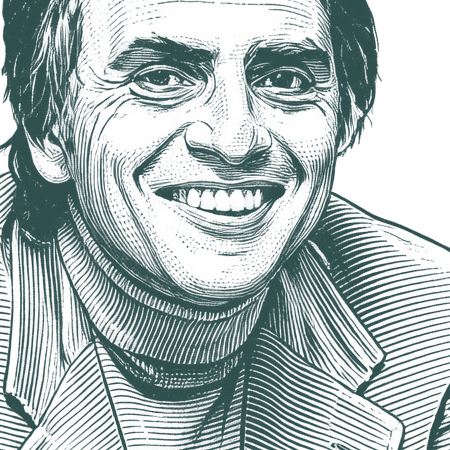
It has been said that astronomy is a humbling and character-building experience. There is perhaps no better demonstration of the folly of human conce… - Carl Sagan
""
It has been said that astronomy is a humbling and character-building experience. There is perhaps no better demonstration of the folly of human conceits than this distant image of our tiny world. To me, it underscores our responsibility to deal more kindly with one another and to preserve and cherish the pale blue dot, the only home we've ever known.
Carl Edward Sagan (9 November 1934 – 20 December 1996) was an American astronomer, planetary scientist, cosmologist, astrophysicist, astrobiologist, author, and science communicator. His best known scientific contribution is research on extraterrestrial life, including experimental demonstration of the production of amino acids from basic chemicals by radiation. Sagan assembled the first physical messages sent into space, the Pioneer plaque and the Voyager Golden Record, universal messages that could potentially be understood by any extraterrestrial intelligence that might find them. Sagan argued the hypothesis, accepted since, that the high surface temperatures of Venus can be attributed to, and calculated using, the greenhouse effect. He testified to the US Congress in 1985 that the greenhouse effect will change the earth's climate system.
Biography information from
Wikiquote·
Portrait adapted from
Wikimedia Commons, NASA/JPL (Public domain / CC0)
Also Known As
Native Name:
Carl Edward Sagan
Alternative Names:
Sagan
•
Carl E. Sagan
•
Carl E Sagan
•
C. E. Sagan
•
C.E. Sagan
•
C E Sagan
•
C. Sagan
•
C Sagan
•
Sagan C
•
Sagan C.
•
Sagan C. E.
•
Sagan CE
You can't convince a believer of anything; for their belief is not based on evidence, it's based on a deep seated need to believe
Pseudoscience speaks to powerful emotional needs that science often leaves unfulfilled. It caters to fantasies about personal powers we lack and long for.
PREMIUM FEATURE
Advanced Search Filters
Filter search results by source, date, and more with our premium search tools.
"Eskiçağ dünyasının bilimini çok aştık. Fakat bilim tarihine ilişkin bilgilerimizde büyük boşluklar var. Bunları doldurmak olanaksız. Günümüzde bir kitaplık okuyucusunun hangi kitabı okuduğunu gösteren kart gibi o zamanki bir kart elimize geçse kim bilir ne bilgiler edinebilir? Biliyoruz ki, Berossus adında Babilli bir rahibin yazdığı üç ciltlik "Dünya Tarihi" kayıptır. Bu kitabın ilk cildinin dünyanın yaratılışından Tufan'a kadar uzanan dönemi içerdiği sanılıyor. Sözü geçen kitapta yazar, bu dönemi 432.000 yıl olarak belirttiğine göre, Tevrat kronolojisinin yüz katı bir zamanı kapsıyor demektir. Merak ederim, acaba o kitapta ne vardı?..."