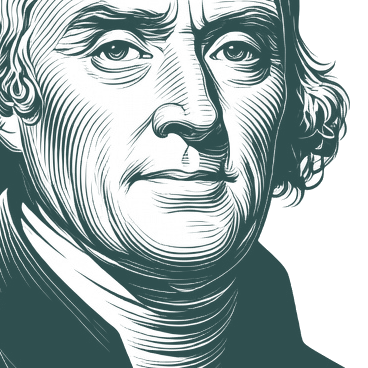
A Decalogue of Canons for Observation in Practical Life:
1. Never put off to tomorrow what you can do to-day.
2. Never trouble another with what yo… - Thomas Jefferson
""
A Decalogue of Canons for Observation in Practical Life:
1. Never put off to tomorrow what you can do to-day.
2. Never trouble another with what you can do yourself.
3. Never spend your money before you have it.
4. Never buy a thing you do not want, because it is cheap, it will be dear to you.
5. Take care of your cents: Dollars will take care of themselves.
6. Pride costs us more than hunger, thirst and cold.
7. We never repent of having eat too little.
8. Nothing is troublesome that one does willingly.
9. How much pain have cost us the evils which have never happened.
10. Take things always by their smooth handle.
11. Think as you please, and so let others, and you will have no disputes.
12. When angry, count 10. before you speak; if very angry, 100.
Thomas Jefferson (13 April 1743 – 4 July 1826) was author of the Declaration of Independence (1776) and the Virginia Statute for Religious Freedom (1777), founder of the University of Virginia (1819), the third president of the United States (1801–1809), a political philosopher, editor of Jefferson's Bible (1819), and one of the most influential founders of the United States.
Biography information from
Wikiquote·
Portrait adapted from
Wikimedia Commons, Rembrandt Peale (Public domain / CC0)
Also Known As
Alternative Names:
President Jefferson
•
T. Jefferson
We concur in considering the government of England as totally without morality, insolent beyond bearing, inflated with vanity and ambition, aiming at the exclusive dominion of the sea, lost in corruption, of deep-rooted hatred towards us, hostile to liberty wherever it endeavors to show its head, and the eternal disturber of the peace of the world. In our estimate of Bonaparte, I suspect we differ. [...] Our form of government is odious to him, as a standing contrast between republican and despotic rule; and as much from that hatred, as from ignorance in political economy, he had excluded intercourse between us and his people, by prohibiting the only articles they wanted from us, that is, cotton and tobacco. Whether the war we have had with England, and the achievements of that war, and the hope that we may become his instruments and partisans against that enemy, may induce him, in future, to tolerate our commercial intercourse with his people, is still to be seen. For my part, I wish that all nations may recover and retain their independence; that those which are overgrown may not advance beyond safe measures of power, that a salutary balance may be ever maintained among nations, and that our peace, commerce, and friendship, may be sought and cultivated by all. It is our business to manufacture for ourselves whatever we can, to keep our markets open for what we can spare or want; and the less we have to do with the amities or enmities of Europe, the better. Not in our day, but at no distant one, we may shake a rod over the heads of all, which may make the stoutest of them tremble. But I hope our wisdom will grow with our power, and teach us, that the less we use our power, the greater it will be.
Treasury notes of small as well as high denomination, bottomed on a tax which would redeem them in ten years, would place at our disposal the whole circulating medium of the United States... The public... ought never more to permit its being filched from them by private speculators and disorganizers of the circulation.
Works in ChatGPT, Claude, or Any AI
Add semantic quote search to your AI assistant via MCP. One command setup.
Like a dropsical man calling out for water, water, our deluded citizens are clamoring for more banks, more banks. The American mind is now in that state of fever which the world has so often seen in the history of other nations. We are under the bank bubble, as England was under the South Sea bubble, France under the Mississippi bubble, and as every nation is liable to be, under whatever bubble, design, or delusion may puff up in moments when off their guard. We are now taught to believe that legerdemain tricks upon paper can produce as solid wealth as hard labor in the earth. It is vain for common sense to urge that nothing can produce nothing; that it is an idle dream to believe in a philosopher’s stone which is to turn everything into gold, and to redeem man from the original sentence of his Maker, “in the sweat of his brow shall he eat his bread.”