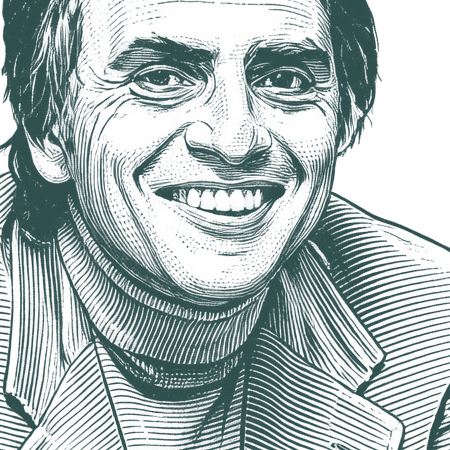
We must surrender our skepticism only in the face of rock-solid evidence. Science demands a tolerance for ambiguity. - Carl Sagan
""
We must surrender our skepticism only in the face of rock-solid evidence. Science demands a tolerance for ambiguity.
English
Collect this quote
About
Carl Sagan
Carl Edward Sagan (9 November 1934 – 20 December 1996) was an American astronomer, planetary scientist, cosmologist, astrophysicist, astrobiologist, author, and science communicator. His best known scientific contribution is research on extraterrestrial life, including experimental demonstration of the production of amino acids from basic chemicals by radiation. Sagan assembled the first physical messages sent into space, the Pioneer plaque and the Voyager Golden Record, universal messages that could potentially be understood by any extraterrestrial intelligence that might find them. Sagan argued the hypothesis, accepted since, that the high surface temperatures of Venus can be attributed to, and calculated using, the greenhouse effect. He testified to the US Congress in 1985 that the greenhouse effect will change the earth's climate system.
Biography information from
Wikiquote·
Portrait adapted from
Wikimedia Commons, NASA/JPL (Public domain / CC0)
Also Known As
Native Name:
Carl Edward Sagan
Alternative Names:
Sagan
•
Carl E. Sagan
•
Carl E Sagan
•
C. E. Sagan
•
C.E. Sagan
•
C E Sagan
•
C. Sagan
•
C Sagan
•
Sagan C
•
Sagan C.
•
Sagan C. E.
•
Sagan CE
Science by itself cannot advocate courses of human action, but it can certainly illuminate the possible consequences of alternative courses of action.
Of all the planets, moons, asteroids, and comets in our Solar System, there is fire only on Earth — because there are large amounts of oxygen gas, O2, only on Earth. Fire was, much later, to have profound consequences for life and intelligence. One thing leads to another.
Enhance Your Quote Experience
Enjoy ad-free browsing, unlimited collections, and advanced search features with Premium.
There is in the lovely Martian landscape not a footprint, not an artifact, not even an old beer can, not a blade of grass, not a kangaroo rat, not even, so far as we can tell, a microbe. Mars and the Moon and Venus... the only planets that we've landed on—are utterly lifeless. ...in our solar system we may discover that there is life only on this world. This says that life is not guaranteed, that life requires something special, something improbable.