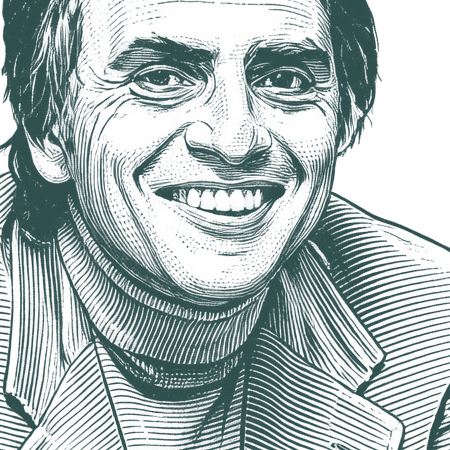
We must surrender our skepticism only in the face of rock-solid evidence. Science demands a tolerance for ambiguity. Where we are ignorant, we withho… - Carl Sagan
""
We must surrender our skepticism only in the face of rock-solid evidence. Science demands a tolerance for ambiguity. Where we are ignorant, we withhold belief. Whatever annoyance the uncertainty engenders serves a higher purpose: It drives us to accumulate better data. This attitude is the difference between science and so much else. Science offers little in the way of cheap thrills. The standards of evidence are strict. But when followed they allow us to see far, illuminating even a great darkness.
Carl Edward Sagan (9 November 1934 – 20 December 1996) was an American astronomer, planetary scientist, cosmologist, astrophysicist, astrobiologist, author, and science communicator. His best known scientific contribution is research on extraterrestrial life, including experimental demonstration of the production of amino acids from basic chemicals by radiation. Sagan assembled the first physical messages sent into space, the Pioneer plaque and the Voyager Golden Record, universal messages that could potentially be understood by any extraterrestrial intelligence that might find them. Sagan argued the hypothesis, accepted since, that the high surface temperatures of Venus can be attributed to, and calculated using, the greenhouse effect. He testified to the US Congress in 1985 that the greenhouse effect will change the earth's climate system.
Biography information from
Wikiquote·
Portrait adapted from
Wikimedia Commons, NASA/JPL (Public domain / CC0)
Also Known As
Native Name:
Carl Edward Sagan
Alternative Names:
Sagan
•
Carl E. Sagan
•
Carl E Sagan
•
C. E. Sagan
•
C.E. Sagan
•
C E Sagan
•
C. Sagan
•
C Sagan
•
Sagan C
•
Sagan C.
•
Sagan C. E.
•
Sagan CE
In the way that skepticism is sometimes applied to issues of public concern, there is a tendency to belittle, to condescend, to ignore the fact that, deluded or not, supporters of superstition and pseudoscience are human beings with real feelings, who, like the skeptics, are trying to figure out how the world works and what our role in it might be. Their motives are in many cases consonant with science. If their culture has not given them all the tools they need to pursue this great quest, let us temper our criticism with kindness. None of us comes fully equipped.
A handful of sand contains about 10,000 grains, more than the number of stars we can see with the naked eye on a clear night. But the number of stars we can see is only the tiniest fraction of the number of stars that are. What we see at night is the merest smattering of the nearest stars. Meanwhile the Cosmos is rich beyond measure: the total number of stars in the universe is greater than all the grains of sand on all the beaches of the planet Earth.
PREMIUM FEATURE
Advanced Search Filters
Filter search results by source, date, and more with our premium search tools.
We tell children about Santa Claus, the Easter Bunny, and the Tooth Fairy for reasons we think emotionally sound, but then disabuse them of these myths before they've grown. Why retract? Because their well-being as adults depends on them knowing the world as it really is. We worry, and for good reason, about adults who still believe in Santa Claus.