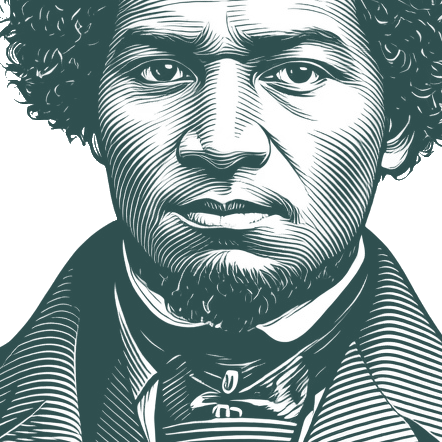
"In about four months after I went to New Bedford, there came a young man to me, and inquired if I did not wish to take the "Liberator." I told him I… - Frederick Douglass
"In about four months after I went to New Bedford, there came a young man to me, and inquired if I did not wish to take the "Liberator." I told him I did; but, just having made my escape from slavery, I remarked that I was unable to pay for it then. I, however, finally became a subscriber to it. The paper came, and I read it from week to week with such feelings as it would be quite idle for me to attempt to describe. The paper became my meat and my drink. My soul was set all on fire. Its sympathy for my brethren in bonds — its scathing denunciations of slaveholders — its faithful exposures of slavery — and its powerful attacks upon the upholders of the institution — sent a thrill of joy through my soul, such as I had never felt before!"
Frederick Douglass (c. February 1818 – 20 February 1895) was an American abolitionist, orator, author, editor, reformer, women's rights advocate, and statesman during the American Civil War. He was born a slave in Maryland, as Frederick Augustus Washington Bailey.
Biography information from
Wikiquote·
Portrait adapted from
Wikimedia Commons, Engraved by J.C. Buttre from a daguerreotype. (Public domain / CC0)
Also Known As
Birth Name:
Frederick Augustus Washington Bailey
Alternative Names:
Frederick Augustus Washington Baly
•
Fred Bailey
•
Freddie Bailey
I have observed this in my experience of slavery, — that whenever my condition was improved, instead of its increasing my contentment, it only increased my desire to be free, and set me to thinking of plans to gain my freedom. I have found that, to make a contented slave, it is necessary to make a thoughtless one. It is necessary to darken his moral and mental vision, and, as far as possible, to annihilate the power of reason. He must be able to detect no inconsistencies in slavery; he must be made to feel that slavery is right; and he can be brought to that only when he ceased to be a man.
You profess to believe "that, of one blood, God made all nations of men to dwell on the face of all the earth," and hath commanded all men, everywhere to love one another; yet you notoriously hate, (and glory in your hatred), all men whose skins are not colored like your own. You declare, before the world, and are understood by the world to declare, that you "hold these truths to be self evident, that all men are created equal; and are endowed by their Creator with certain inalienable rights; and that, among these are, life, liberty, and the pursuit of happiness;" and yet, you hold securely, in a bondage which, according to your own Thomas Jefferson, "is worse than ages of that which your fathers rose in rebellion to oppose," a seventh part of the inhabitants of your country.
Try QuoteGPT
Chat naturally about what you need. Each answer links back to real quotes with citations.
One thing which they ought to do, in order to hold their own against this enemy, is to give up cultivating what they call 'race pride', a sentiment too much like that which is 'the lion in the way' of our progress... Do we not know that every argument we make, and every pretension we set up in favor of race pride, is giving the enemy a stick to break our own heads? ... You will, perhaps, think this criticism uncalled for. My answer is that truth is never uncalled for... In some of our colored public journals I have seen myself charged with a lack of race pride. I am not ashamed of that charge. I have no apology or vindication to offer. If fifty years of uncompromising devotion to the cause of the colored man in this country does not vindicate me, I am content to live without vindication. While I have no more reason to be proud of one race than another, I dare to say, and I fear no contradiction, that there is no other man in the United States prouder than myself of any great achievement, mental or mechanical, of which any colored man or woman is the author. This not because I am a colored man, but because I am a man; and because color is a misfortune, and is treated as a crime by the American people.