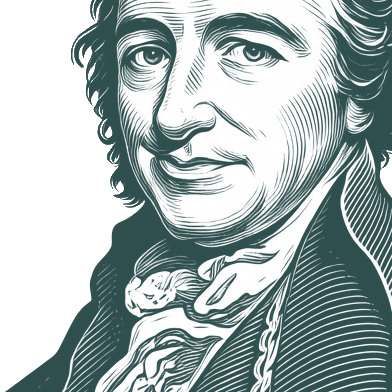
From the errors of other nations, let us learn wisdom, - Thomas Paine
""
From the errors of other nations, let us learn wisdom,
English
Collect this quote
About
Thomas Paine
Thomas Paine (February 9, 1737 [O.S. January 29, 1736] – 8 June 1809) was a British-American political writer, theorist, and activist who had a great influence on the thoughts and ideas which led to the American Revolution and the United States Declaration of Independence. He wrote three of the most influential and controversial works of the 18th Century: Common Sense, Rights of Man, and The Age of Reason. His ideas reflected Enlightenment-era ideals of transnational human rights.
Biography information from
Wikiquote·
Portrait adapted from
Wikimedia Commons, Auguste Millière / After George Romney / After William Sharp (Public domain / CC0)
Portrait from Wikimedia Commons. Credit: Auguste Millière / After George Romney / After William Sharp. Used under Public domain / CC0. Processed and styled by Quotewise.
Unlimited Quote Collections
Organize your favorite quotes without limits. Create themed collections for every occasion with Premium.
Not content with this deification of Satan, they represent him as defeating, by stratagem, in the shape of an animal of the creation, all the power and wisdom of the Almighty. They represent him as having compelled the Almighty to the direct necessity either of surrendering the whole of the creation to the government and sovereignty of this Satan, or of capitulating for its redemption by coming down upon earth, and exhibiting himself upon a cross in the shape of a man.
I recollect not a single passage in all the writings ascribed to the men called apostles, that conveys any idea of what God is. Those writings are chiefly controversial; and the subjects they dwell upon, that of a man dying in agony on a cross, is better suited to the gloomy genius of a monk in a cell, by whom it is not impossible they were written, than to any man breathing the open air of the Creation.
I speak a language full and intelligible. I deal not in hints and intimations. [...] First, that I may be clearly understood. Secondly, that it may be seen I am in earnest; and, thirdly, because it is an affront to truth to treat falsehood with complaisance.