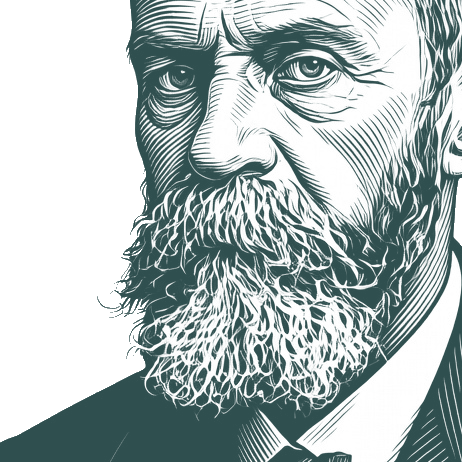
The error is needed to set off the truth, much as a dark background is required for exhibiting the brightness of a picture. - William James
""
The error is needed to set off the truth, much as a dark background is required for exhibiting the brightness of a picture.
English
Collect this quote
About
William James
William James (11 January 1842 – 26 August 1910) was a pioneering American psychologist and philosopher. He developed the philosophical perspective known as radical empiricism, and wrote influential books on the science of psychology, the psychology of religious experience and mysticism, and the philosophy of pragmatism.
Biography information from
Wikiquote·
Portrait adapted from
Wikimedia Commons, Alice Boughton (Public domain / CC0)
We have grown literally afraid to be poor. We despise anyone who elects to be poor in order to simplify and save his inner life. If he does not join the general scramble and pant with the money-making street, we deem him spiritless and lacking in ambition
The most violent revolutions in an individual's beliefs leave most of his old order standing. Time and space, cause and effect, nature and history, and one's own biography remain untouched. New truth is always a go-between, a smoother-over of transitions. It marries old opinion to new fact so as ever to show a minimum of jolt, a maximum of continuity.
Works in ChatGPT, Claude, or Any AI
Add semantic quote search to your AI assistant via MCP. One command setup.
It is as if there were in the human consciousness a sense of reality, a feeling of objective presence, a perception of what we may call ‘something there,’ more deep and more general than any of the special and particular ‘senses’ by which the current psychology supposes existent realities to be originally revealed. If this were so, we might suppose the senses to waken our attitudes and conduct as they so habitually do, by first exciting this sense of reality; but anything else, any idea, for example, that might similarly excite it, would have that same prerogative of appearing real which objects of sense normally possess.