Our civilization has decided, and very justly decided, that determining the guilt or innocence of men is a thing too important to be trusted to train… - G. K. Chesterton
""
Our civilization has decided, and very justly decided, that determining the guilt or innocence of men is a thing too important to be trusted to trained men. It wishes for light upon that awful matter, it asks men who know no more law than I know, but who can feel the thing that I felt in that jury box. When it wants a library catalogued, or the solar system discovered, or any trifle of that kind, it uses up its specialists. But when it wishes anything done which is really serious, it collects twelve of the ordinary men standing round. The same thing was done, if I remember right, by the Founder of Christianity.
English
Collect this quote
About
G. K. Chesterton
Gilbert Keith Chesterton (29 May 1874 – 14 June 1936) was a British writer whose prolific and diverse output included works of philosophy, ontology, poetry, play writing, journalism, public lecturing and debating, literary and art criticism, biography, Christian apologetics (particularly for Catholicism), and fiction, including fantasy and detective fiction. He has been called the "prince of paradox".
Biography information from
Wikiquote·
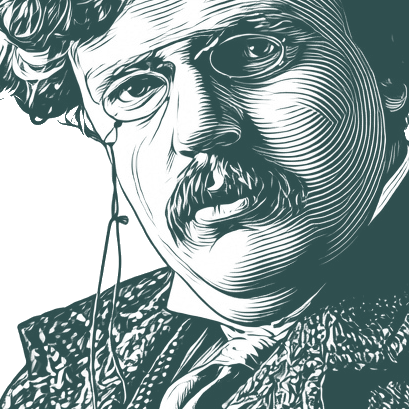
Portrait adapted from
Wikimedia Commons, Ernest Herbert Mills (Public domain / CC0)
Also Known As
Native Name:
Gilbert Keith Chesterton
Alternative Names:
František Kafka
•
Kafka
•
Gilbert K. Chesterton
•
Gilbert Chesterton
•
G.K. Chesterton
•
G. K. C.
We make our friends; we make our enemies; but God makes our next door neighbors.
"I will go forth as a real outlaw," he said, "and as men do robbery on the highway I will do right on the highway; and it will be counted a wilder crime."
Works in ChatGPT, Claude, or Any AI
Add semantic quote search to your AI assistant via MCP. One command setup.
"In the matter of reforming things, as distinct from deforming them, there is one plain and simple principle; a principle which will probably be called a paradox. There exists in such a case a certain institution or law; let us say, for the sake of simplicity, a fence or gate erected across a road. The more modern type of reformer goes gaily up to it and says, "I don't see the use of this; let us clear it away." To which the more intelligent type of reformer will do well to answer: "If you don't see the use of it, I certainly won't let you clear it away. Go away and think. Then, when you can come back and tell me that you do see the use of it, I may allow you to destroy it."
This paradox rests on the most elementary common sense. The gate or fence did not grow there. It was not set up by somnambulists who built it in their sleep. It is highly improbable that it was put there by escaped lunatics who were for some reason loose in the street. Some person had some reason for thinking it would be a good thing for somebody. And until we know what the reason was, we really cannot judge whether the reason was reasonable. It is extremely probable that we have overlooked some whole aspect of the question, if something set up by human beings like ourselves seems to be entirely meaningless and mysterious. There are reformers who get over this difficulty by assuming that all their fathers were fools; but if that be so, we can only say that folly appears to be a hereditary disease. But the truth is that nobody has any business to destroy a social institution until he has really seen it as an historical institution. If he knows how it arose, and what purposes it was supposed to serve, he may really be able to say that they were bad purposes, that they have since become bad purposes, or that they are purposes which are no longer served. But if he simply stares at the thing as a senseless monstrosity that has somehow sprung up in his path, it is he and not the traditionalist who is