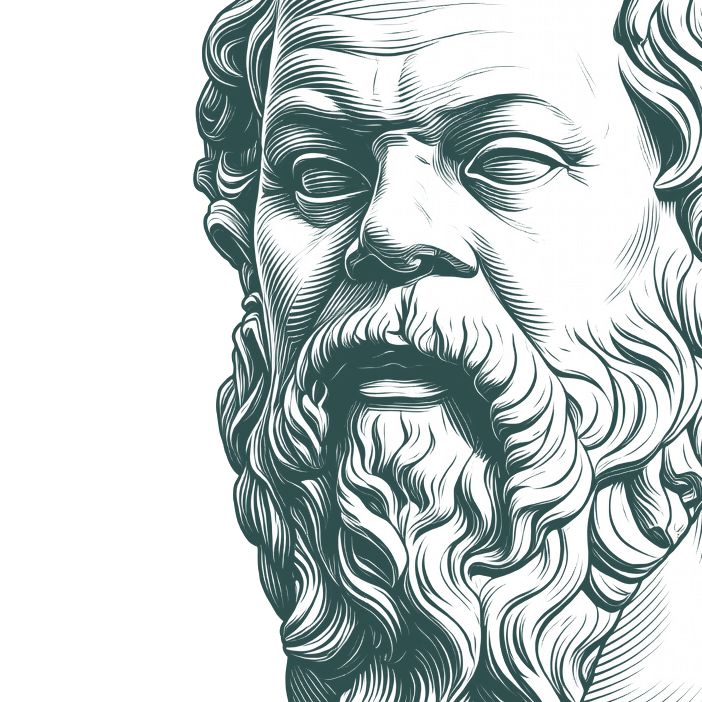
Socrates (Σωκράτης; c. 470 BC – 399 BC) was a classical Greek (Athenian) philosopher credited as one of the founders of Western philosophy. Through his portrayal in Plato's dialogues, Socrates has become renowned for his contribution to the field of ethics, and it is this Platonic Socrates who lends his name to the concepts of Socratic irony and the Socratic method, or elenchus. The latter remains a commonly used tool in a wide range of discussions, and is a type of pedagogy in which a series of questions is asked not only to draw individual answers, but also to encourage fundamental insight into the issue at hand.
Biography information from
Wikiquote·
Portrait adapted from
Wikimedia Commons, Copy of Lysippos (?) (Public domain / CC0)
It is the example of the rider who wishes to become an expert horseman: "None of your soft-mouthed, docile animals for me," he says; "the horse for me to own must show some spirit" in the belief, no doubt, if he can manage such an animal, it will be easy enough to deal with every other horse besides. And that is just my case. I wish to deal with human beings, to associate with man in general; hence my choice of wife. I know full well, if I can tolerate her spirit, I can with ease attach myself to every human being else.
My plainness of speech makes them hate me, and what is their hatred but a proof that I am speaking the truth.
Enhance Your Quote Experience
Enjoy ad-free browsing, unlimited collections, and advanced search features with Premium.