Amal: It isn't sad. When they shut me in here first I felt the day was so long. Since the King's Post Office I like it more and more being indoors, a… - Rabindranath Tagore
""
Amal: It isn't sad. When they shut me in here first I felt the day was so long. Since the King's Post Office I like it more and more being indoors, and as I think I shall get a letter one day, I feel quite happy and then I don't mind being quiet and alone. I wonder if I shall make out what'll be in the King's letter?
Gaffer: Even if you didn't wouldn't it be enough if it just bore your name?
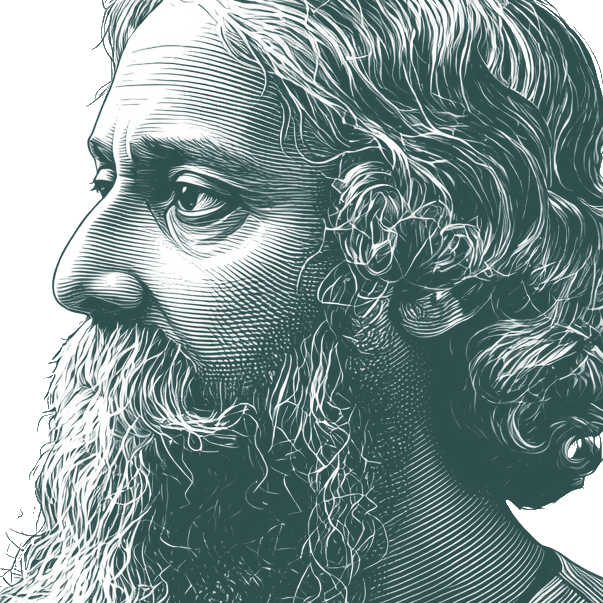
Rabindranath Tagore (7 May 1861 – 7 August 1941), also known as Rabi Thakur, was a Bengali philosopher, poet, and winner of the Nobel Prize for literature in 1913.
Biography information from
Wikiquote·
Portrait adapted from
Wikimedia Commons, Generalstabens litografiska anstalt (Public domain / CC0)
Whenever a Muslim called upon the Muslim society, he never faced any resistance-he called in the name of one God ‘Allah-ho-Akbar’. On the other hand, when we (Hindus) call will call, ‘come on, Hindus’, who will respond? We, the Hindus, are divided in numerous small communities, many barriers-provincialism-who will respond overcoming all these obstacles? “We suffered from many dangers, but we could never be united. When Mohammed Ghouri brought the first blow from outside, the Hindus could not be united, even in the those days of imminent danger. When the Muslims started to demolish the temples one after another, and to break the idols of Gods and Goddesses, the Hindus fought and died in small units, but they could not be united. It has been provided that we were killed in different ages due to out discord. Weakness harbors sin. So, if the Muslims beat us and we, the Hindus, tolerate this without resistance-then, we will know that it is made possible only by our weakness. For the sake of ourselves and our neighbour Muslims also, we have to discard our weakness. We can appeal to our neighbour Muslims, `Please don't be cruel to us. No religion can be based on genocide' - but this kind of appeal is nothing, but the weeping of the weak person. When the low pressure is created in the air, storm comes spontaneously; nobody can stop it for sake for religion. Similarly, if weakness is cherished and be allowed to exist, torture comes automatically - nobody can stop it. Possibly, the Hindus and the Muslims can make a fake friendship to each other for a while, but that cannot last forever. As long as you don’t purify the soil, which grows only thorny shrubs you can not expect any fruit.
to tyrannize for the country is to tyrannize over the country
I had gone a-begging from door to door in the village path, when thy golden chariot appeared in the distance like a gorgeous dream and I wondered who was this King of all kings!
My hopes rose high and methought my evil days were at an end, and I stood waiting for alms to be given unasked and for wealth scattered on all sides in the dust.
The chariot stopped where I stood. Thy glance fell on me and thou camest down with a smile. I felt that the luck of my life had come at last. Then of a sudden thou didst hold out thy right hand and say `What hast thou to give to me?'
Ah, what a kingly jest was it to open thy palm to a beggar to beg! I was confused and stood undecided, and then from my wallet I slowly took out the least little grain of corn and gave it to thee.
But how great my surprise when at the day's end I emptied my bag on the floor to find a least little gram of gold among the poor heap. I bitterly wept and wished that I had had the heart to give thee my all.