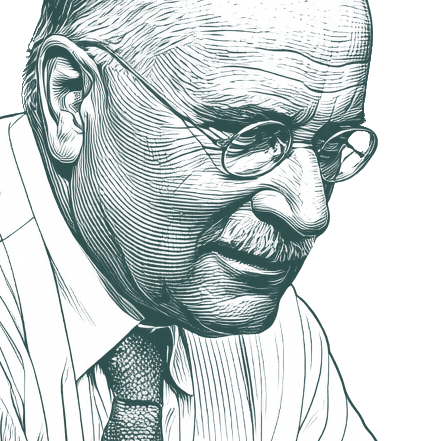
INTUITION (L. intueri, ‘to look at or into’). I regard intuition as a basic psychological function (q.v.). It is the function that mediates perceptio… - Carl Jung
""
INTUITION (L. intueri, ‘to look at or into’). I regard intuition as a basic psychological function (q.v.). It is the function that mediates perceptions in an unconscious way. Everything, whether outer or inner objects or their relationships, can be the focus of this perception. The peculiarity of intuition is that it is neither sense perception, nor feeling, nor intellectual inference, although it may also appear in these forms. In intuition a content presents itself whole and complete, without our being able to explain or discover how this content came into existence. Intuition is a kind of instinctive apprehension, no matter of what contents. Like sensation (q.v.), it is an irrational (q.v.) function of perception. As with sensation, its contents have the character of being “given,” in contrast to the “derived” or “produced” character of thinking and feeling (qq.v.) contents. Intuitive knowledge possesses an intrinsic certainty and conviction, which enabled Spinoza (and Bergson) to uphold the scientia intuitiva as the highest form of knowledge. Intuition shares this quality with sensation (q.v.), whose certainty rests on its physical foundation. The certainty of intuition rests equally on a definite state of psychic “alertness” of whose origin the subject is unconscious.
Your vision will become clear only when you can look into your own heart. Without, everything seems discordant; only within does it coalesce into unity. Who looks outside dreams; who looks inside awakes.
Faith, hope, love, and insight are the highest achievements of human effort. They are found-given-by experience.
Go Premium
Support Quotewise while enjoying an ad-free experience and premium features.
No nation keeps its word. A nation is a big, blind worm, following what? Fate perhaps. A nation has no honour, it has no word to keep. ... Hitler is himself the nation. That incidentally is why Hitler always has to talk so loud, even in private conversation — because he is speaking with 78 million voices.