[T]he first philosophers, in investigating the truth and the nature of things, wandered, as if led by ignorance, into a certain... path. Hence, they … - Aristotle
""
[T]he first philosophers, in investigating the truth and the nature of things, wandered, as if led by ignorance, into a certain... path. Hence, they say that no being is either generated or corrupted, because it is necessary that what is generated should be generated either from being or non-being: but both these are impossible; for neither can being be generated, since it already is; and from nothing, nothing can be generated... And thus... they said that there were not many things, but that being alone had a subsistence. ...the ancient philosophers ...through this ignorance added so much to their want of knowledge, as to fancy that nothing else was generated or had a being; but they subverted all generation.
English
Collect this quote
About
Aristotle
Aristotle (Ἀριστοτέλης Aristotelēs; 384 BC – 322 BC) was a Greek philosopher and polymath during the Classical period in Ancient Greece. Taught by Plato, he was the teacher of Theophrastus and founder of the Lyceum, the Peripatetic school of philosophy, and the Aristotelian tradition. His writings cover many subjects including physics, biology, zoology, metaphysics, logic, ethics, aesthetics, poetry, theatre, music, rhetoric, psychology, linguistics, economics, politics, meteorology, geology and government. Aristotle provided a complex synthesis of the various philosophies existing prior to him. It was above all from his teachings that the West inherited its intellectual lexicon, as well as problems and methods of inquiry. As a result, his philosophy has exerted a unique influence on almost every form of knowledge in the West and it continues to be a subject of contemporary philosophical discussion.
Biography information from
Wikiquote·
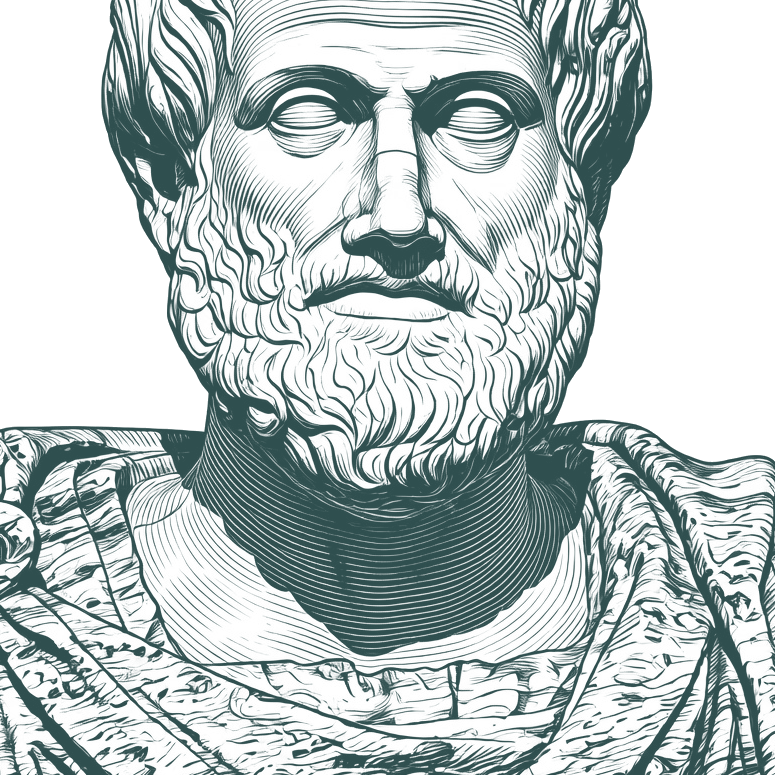
Portrait adapted from
Wikimedia Commons, After Lysippos (Public domain / CC0)
Also Known As
Native Name:
Ἀριστοτέλης
Alternative Names:
the Stagirite
•
Aristotelis
•
Aristoteles
But it is better to assume principles less in number and finite, as Empedocles makes them to be. All philosophers... make principles to be contraries... (for Parmenides makes principles to be hot and cold, and these he demominates fire and earth) as those who introduce as principles the rare and the dense. But Democritus makes the principles to be the solid and the void; of which the former, he says, has the relation of being, and the latter of non-being. ...it is necessary that principles should be neither produced from each other, nor from other things; and that from these all things should be generated. But these requisites are inherent in the first contraries: for, because they are first, they are not from other things; and because they are contraries, they are not from each other.
If one way be better than another, that you may be sure is nature's way.