When we see the giant, why do we automatically assume the battle is his for the winning? - Malcolm Gladwell
""
When we see the giant, why do we automatically assume the battle is his for the winning?
English
Collect this quote
About
Malcolm Gladwell
Malcolm Timothy Gladwell (born September 3, 1963) is an English-born Canadian journalist, bestselling author, and speaker. He has been a staff writer for The New Yorker since 1996.
Biography information from
Wikiquote·
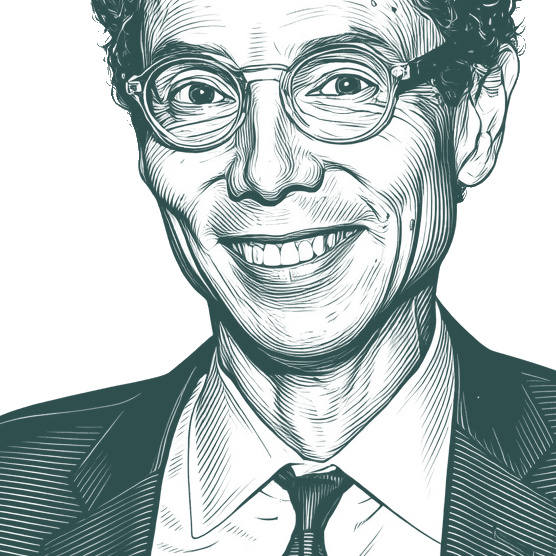
Portrait adapted from
Wikimedia Commons, PEN American Center (CC BY)
Hard work is a prison sentence only if it does not have meaning.
Why is a two-year-old so terrible? Because she is systematically testing the fascinating and, to her, utterly novel notion that something that gives her pleasure might not actually give someone else pleasure — and the truth is that as adults we never lose that fascination.
Sometimes the best conversations between strangers allow the stranger to remain a stranger.
We jump at the chance to judge strangers. We would never do that to ourselves, of course. We are nuanced and complex and enigmatic. But the stranger is easy. If I can convince you of one thing in this book, let it be this: Strangers are not easy.
The issue with spies is not that there is something brilliant about them. It is that there is something wrong with us.
You believe someone not because you have no doubts about them. Belief is not the absence of doubt. You believe someone because you don’t have enough doubts about them.
Those who are not part of existing social hierarchies are free to blurt out inconvenient truths or question things the rest of us take for granted.
The advantage to human beings lies in assuming that strangers are truthful.
If you don’t begin in a state of trust, you can’t have meaningful social encounters.
But remember, doubts are not the enemy of belief; they are its companion.
Our strategies for dealing with strangers are deeply flawed, but they are also socially necessary.
We tend to judge people’s honesty based on their demeanor. Well-spoken, confident people with a firm handshake who are friendly and engaging are seen as believable. Nervous, shifty, stammering, uncomfortable people who give windy, convoluted explanations aren’t.
We do not understand the importance of the context in which the stranger is operating.
When you confront the stranger, you have to ask yourself where and when you’re confronting the stranger — because those two things powerfully influence your interpretation of who the stranger is.
Don’t look at the stranger and jump to conclusions. Look at the stranger’s world.