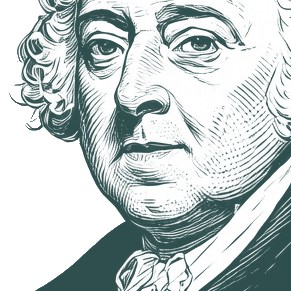
Statesmen, my dear Sir, may plan and speculate for Liberty, but it is Religion and Morality alone, which can establish the Principles upon which Free… - John Adams
""
Statesmen, my dear Sir, may plan and speculate for Liberty, but it is Religion and Morality alone, which can establish the Principles upon which Freedom can securely stand. The only foundation of a free Constitution is pure Virtue, and if this cannot be inspired into our People in a greater Measure than they have it now, They may change their Rulers and the forms of Government, but they will not obtain a lasting Liberty. They will only exchange Tyrants and Tyrannies.
John Adams (30 October 1735 – 4 July 1826) was an American lawyer, author, statesman, and diplomat. He served as the second president of the United States (1797–1801), the first vice president (1789–1797), and as a Founding Father was a leader of American independence from the British Empire. Adams was a political theorist in the Age of Enlightenment who promoted republicanism and a strong central government. His innovative ideas were frequently published. He was also a dedicated diarist and correspondent, particularly with his wife and key advisor Abigail. He was the father of John Quincy Adams.
Biography information from
Wikiquote·
Portrait adapted from
Wikimedia Commons, Gilbert Stuart (Public domain / CC0)
Related quotes. More quotes will automatically load as you scroll down, or you can use the load more buttons.
Shorter versions of this quote
Statesmen, my dear Sir, may plan and speculate for Liberty, but it is Religion and Morality alone, which can establish the Principles upon which Freedom can securely stand.
In order to be fully convinced of this, we must take an extensive view of the subject; and the first inquiry should be, what kind of beings men are? You and I admire the fable of Tristram Shandy more than the fable of the Bees, and agree with Butler rather than Hobbes. It is weakness rather than wickedness, which renders men unfit to be trusted with unlimited power.
There never was yet a people who must not have somebody or something to represent the dignity of the state, the majesty of the people, call it what you will — a doge, an avoyer, an archon, a president, a consul, a syndic; this becomes at once an object of ambition and dispute, and, in time, of division, faction, sedition, and rebellion.
Go Premium
Support Quotewise while enjoying an ad-free experience and premium features.
From individual independence he proceeded to association. If it was inconsistent with the dignity of human nature to say that men were gregarious animals, like wild horses and wild geese, it surely could offend no delicacy to say they were social animals by nature, that there were mutual sympathies, and, above all, the sweet attraction of the sexes, which must soon draw them together in little groups, and by degrees in larger congregations, for mutual assistance and defence. And this must have happened before any formal covenant, by express words or signs, was concluded. When general counsels and deliberations commenced, the objects could be no other than the mutual defence and security of every individual for his life, his liberty, and his property. To suppose them to have surrendered these in any other way than by equal rules and general consent was to suppose them idiots or madmen, whose acts were never binding. To suppose them surprised by fraud, or compelled by force, into any other compact, such fraud and such force could confer no obligation. Every man had a right to trample it under foot whenever he pleased. In short, he asserted these rights to be derived only from nature and the author of nature; that they were inherent, inalienable, and indefeasible by any laws, pacts, contracts, covenants, or stipulations, which man could devise.