Now I say this to keep the conscience free from mischievous laws and fictitious sins, and not because I would defend images. Nor would I condemn thos… - Martin Luther King Jr.
""
Now I say this to keep the conscience free from mischievous laws and fictitious sins, and not because I would defend images. Nor would I condemn those who have destroyed them, especially those who destroy divine and idolatrous images. But images for memorial and witness, such as crucifixes and images of saints, are to be tolerated.
English
Collect this quote
About
Martin Luther King Jr.
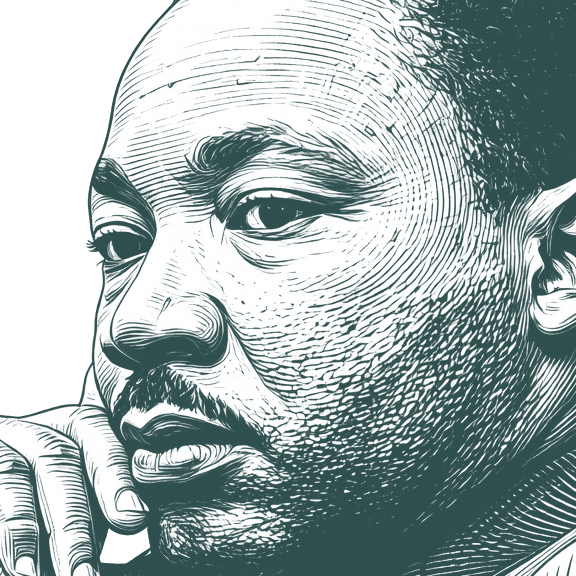
Dr. Martin Luther King Jr. (15 January 1929 – 4 April 1968) was an American Baptist minister, civil rights activist, and recipient of the Nobel Peace Prize of 1964. He was the husband of Coretta Scott King, and father of Yolanda King and Martin Luther King III.
Biography information from
Wikiquote·
Portrait adapted from
Wikimedia Commons, Yoichi Okamoto (Public domain / CC0)
Also Known As
Birth Name:
Michael King Jr.
Alternative Names:
Martin Luther King, Jr.
•
Dr. Martin Luther King, Jr.
•
Martin Luther King
•
Michael King
•
Dr. King
•
M. L. King
•
M.L. King
•
ML King
•
MLK
•
Martin Luther King Junior
•
Michael King Junior
•
Rev. Dr. Martin Luther King Jr.
•
The Rev. Dr. Martin Luther King Jr.
Many people fear nothing more terribly than to take a position which stands out sharply and clearly from the prevailing opinion. The tendency of most is to adopt a view that is so ambiguous that it will include everything and so popular that it will include everybody. Not a few men who cherish lofty and noble ideals hide them under a bushel for fear of being called different.
And the other thing is that it causes one to engage ultimately in activities that are merely used to get attention. Criminologists tell us that some people are driven to crime because of this drum major instinct. They don't feel that they are getting enough attention through the normal channels of social behavior, and so they turn to anti-social behavior in order to get attention, in order to feel important. And so they get that gun, and before they know it they robbed a bank in a quest for recognition, in a quest for importance.
Go Premium
Support Quotewise while enjoying an ad-free experience and premium features.
You may well ask: "Why direct action? Why sit ins, marches and so forth? Isn't negotiation a better path?" You are quite right in calling for negotiation. Indeed, this is the very purpose of direct action. Nonviolent direct action seeks to create such a crisis and foster such a tension that a community which has constantly refused to negotiate is forced to confront the issue. It seeks so to dramatize the issue that it can no longer be ignored. My citing the creation of tension as part of the work of the nonviolent resister may sound rather shocking. But I must confess that I am not afraid of the word "tension." I have earnestly opposed violent tension, but there is a type of constructive, nonviolent tension which is necessary for growth. Just as Socrates felt that it was necessary to create a tension in the mind so that individuals could rise from the bondage of myths and half truths to the unfettered realm of creative analysis and objective appraisal, so must we see the need for nonviolent gadflies to create the kind of tension in society that will help men rise from the dark depths of prejudice and racism to the majestic heights of understanding and brotherhood. The purpose of our direct action program is to create a situation so crisis packed that it will inevitably open the door to negotiation.