I know—as we all do—very little of the practice and the spoken and written doctrine of former times on the subject of non-resistance to evil. I knew … - Leo Tolstoy
""
I know—as we all do—very little of the practice and the spoken and written doctrine of former times on the subject of non-resistance to evil. I knew what had been said on the subject by the fathers of the Church—Origen, Tertullian, and others—I knew too of the existence of some so-called sects of Mennonites, Herrnhuters, and Quakers, who do not allow a Christian the use of weapons, and do not enter military service; but I knew little of what had been done by these so-called sects toward expounding the question.
English
Collect this quote
About
Leo Tolstoy
Lev Nikolayevitch Tolstoy [Ле́в Никола́евич Толсто́й, usually rendered Leo Tolstoy, or sometimes Tolstoi] (9 September 1828 – 20 November 1910) was a Russian writer, philosopher and social activist (social critic), whose novels War and Peace and Anna Karenina are internationally praised classics of world literature. He was a major influence on the development of Christian anarchism and pacifism, contributing to such nonviolent resistance movements as those of Mahatma Gandhi, Martin Luther King, Jr., and James Bevel.
Biography information from
Wikiquote·
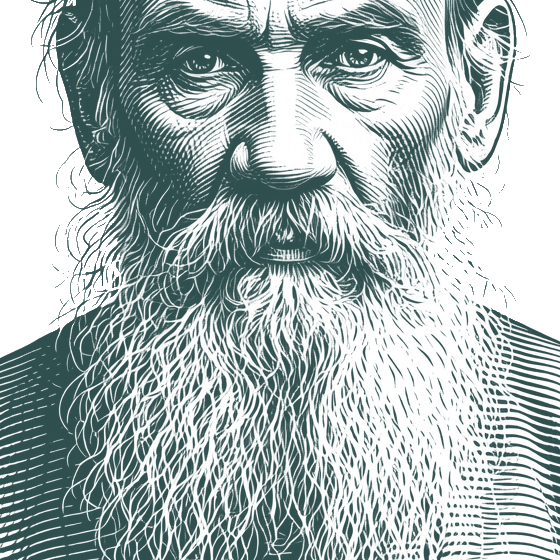
Portrait adapted from
Wikimedia Commons, Sergei Prokudin-Gorskii (Public domain / CC0)
Also Known As
Pen Names:
Л. Н. Т.
•
Л. Н.
Birth Name:
Lev Nikolayevich Tolstoy
Native Name:
Лев Никола́евич Толсто́й
Alternative Names:
Count Lev Nikolayevich Tolstoy
•
Tolstoy, Leo, graf, 1828-1910
•
Tolstoĭ, Lev Nikolaevich, graf, 1828-1910
•
Lev Nikolayevich Tolstoĭ
•
Leo Tolstoi
•
Tolstoĭ, Lev Nikolaevich, graf
•
Tolstoy, Leo, graf
but my life now, my whole life apart from anything that can happen to me, every minute of it is no more meaningless, as it was before, but it has the positive meaning of goodness, which I have the power to put into it.
He knew that Vronsky could not be prevented from amusing himself with painting; he knew that he and all dilettanti had a perfect right to paint what they liked, but it was distasteful to him. A man could not be prevented from making himself a big wax doll, and kissing it. But if the man were to come with the doll and sit before a man in love, and began caressing his doll as the lover caressed the woman he loved, it would be distasteful to the lover. Just such a distasteful sensation was what Mihailov felt at the sight of Vronsky’s painting: he felt it both ludicrous and irritating, both pitiable and offensive.
Go Premium
Support Quotewise while enjoying an ad-free experience and premium features.
The partisans of aesthetic theory denied that it was their own invention, and professed that it existed in the nature of things and even that it was recognized by the ancient Greeks. But... among the ancient Greeks, due to their low grade (compared to the Christian) moral ideal, their conception of the good was not yet sharply distinguished from their conception of the beautiful. That highest conception of goodness (not identical with beauty and for the most part, contrasting with it) discerned by the Jews even in the time of Isaiah and fully expressed by Christianity, was unknown to the Greeks. It is true that the Greek's foremost thinkers — Socrates, Plato, Aristotle — felt that goodness may not coincide with beauty. ...But notwithstanding all this, they could not quite dismiss the notion that beauty and goodness coincide. And consequently in the language of that period a compound word (καλο-κάγαθια, beauty-goodness) came into use to express that notion. Evidently the Greek sages began to draw close to the perception of goodness which is expressed in Buddhism and in Christianity, but they got entangled in defining the relationship between goodness and beauty. And it was just this confusion of ideas that those Europeans of a later age ... tried to elevate into law. ... On this misunderstanding the new science of aesthetics was built.