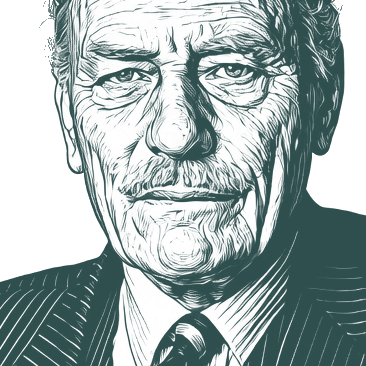
Never again, by the necessity of an axiom, will an Englishman live for his country or die for his country: the country for which people live and die … - Enoch Powell
""
Never again, by the necessity of an axiom, will an Englishman live for his country or die for his country: the country for which people live and die was obsolete and we have abolished it. Or not quite yet. No, not yet. The Referendum is not a ‘verdict’ after which the prisoner is hanged forthwith. It is no more than provisional... This will be so as long as one Parliament can alter or undo whatever that or any other Parliament has done. Hence those golden words in the Government's Referendum pamphlet: ‘Our continued membership will depend on the continuing assent of Parliament.’
John Enoch Powell (16 June 1912 – 8 February 1998) was a British politician, classical scholar, author, linguist, soldier, philologist, and poet. He served as a Conservative Member of Parliament (1950–1974), then Ulster Unionist Party (UUP) MP (1974–1987), and was Minister of Health (1960–1963).
England is the country of the English... England is the stage on which the drama of English history was played and the setting within which the English became conscious of themselves as a people ... when politicians and preachers attempt to frighten and cajole the English into pretending away the distinction between themselves and people of other nations and other origins, they are engaged in undermining the foundation upon which democratic government by consent and peaceable civilised society in this country are supported ... those who at the end of the twentieth century wish to keep alive that consciousness of being English, which seemed so effortless and uncontroversial to our forefathers, will discover that they are called upon, if they take their purpose seriously, to confront the most arrogant and imposing prejudices of their time.
The continuance of India within the British Empire is essential to the Empire's existence and is consequently a paramount interest both of the United Kingdom and of the Dominions...for strategic purposes there is no half-way house between an India fully within the Empire and an India totally outside it...Should it once be admitted or proved that Indians cannot govern themselves except by leaving the Empire – in other words, that the necessary goal of political development for the most important section of His Majesty's non-European subjects is independence and not Dominion status – then the logically inevitable outcome will be the eventual and probably the rapid loss to the Empire of all its other non-European parts. It would extinguish the hope of a lasting union between "white" and "coloured" which the conception of a common subjectship to the King-Emperor affords and to which the development of the Empire hitherto has given the prospect of leading...In discussion of the wealth of India it is usual to forget the principal item, which is four hundred millions of human beings, for the most part belonging to races neither unintelligent nor slothful...[British policy should be to] create the preconditions of democracy and self-government by as soon as possible making India socially and economically a modern state.
PREMIUM FEATURE
Advanced Search Filters
Filter search results by source, date, and more with our premium search tools.
Virtually the entire inflow was therefore Asiatic, and all but three or four thousand of that inflow originated from the Indian subcontinent... It is by 'black Power' that the headlines are caught, and under the shape of the negro that the consequences for Britain of immigration and what is miscalled 'race' are popularly depicted. Yet it is more truly when he looks into the eyes of Asia that the Englishman comes face to face with those who will dispute with him the possession of his native land.