it
would be surprising if I had a clearer grasp of things that I
realize are doubtful, unknown and foreign to me — ·namely,
bodies· — than I have of … - René Descartes
""
it would be surprising if I had a clearer grasp of things that I realize are doubtful, unknown and foreign to me — ·namely, bodies· — than I have of what is true and known — namely my own self. But I see what the trouble is: I keep drifting towards that error because my mind likes to wander freely, refusing to respect the boundaries that truth lays down. Very well, then; I shall let it run free for a while, so that when the time comes to rein it in it won’t be so resistant to being pulled back.
René Descartes (March 31, 1596 – February 11, 1650) was a highly influential French philosopher, mathematician, physicist and writer. He is known for his influential arguments for substance dualism, where mind and body are considered to have distinct essences, one being characterized by thought, the other by spatial extension. He has been dubbed the "Father of Modern Philosophy" and the "Father of Modern Mathematics." He is also known as Cartesius.
Biography information from
Wikiquote·
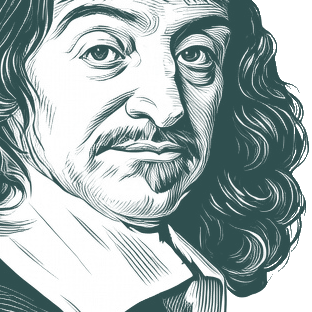
Portrait adapted from
Wikimedia Commons, After Frans Hals (Public domain / CC0)
Είμαι, λοιπόν, εγώ ένα σκεπτόμενο πράγμα, δηλαδή ένα πράγμα που αμφιβάλλει, συμφώνει, αρνείται, αντιλαμβάνεται με το πνεύμα (αν και, προς το παρόν, πολύ λίγα), αγνοεί (σίγουρα ακόμα πολλά), θέλει, δεν θέλει, και ακόμα φαντάζεται και αντιλαμβάνεται (γιατί, όπως έχω ήδη παρατηρήσει, παρότι τα πράγματα που φαντάζομαι και αισθάνομαι ίσως να μην υπάρχουν έξω από εμένα, είμαι βέβαιος ότι αυτά τα είδη σκέψης που αποκαλώ φαντασιώσεις και αισθήματα, μόνο ως είδη σκέψης, βρίσκονται μέσα μου).
...reading good books is like engaging in conversation with the most cultivated minds of past centuries who had composed them, or rather, taking part in a well-conducted dialogue in which such minds reveal to us only the best of their thoughts
Try QuoteGPT
Chat naturally about what you need. Each answer links back to real quotes with citations.
Suppose [a person] had a basket full of apples and, being worried that some of the apples were rotten, wanted to take out the rotten ones to prevent the rot spreading. How would he proceed? Would he not begin by tipping the whole lot out of the basket? And would not the next step be to cast his eye over each apple in turn, and pick up and put back in the basket only those he saw to be sound, leaving the others? In just the same way, those who have never philosophized correctly have various opinions in their minds which they have begun to store up since childhood, and which they therefore have reason to believe may in many cases be false. They then attempt to separate the false beliefs from the others, so as to prevent their contaminating the rest and making the whole lot uncertain. Now the best way they can accomplish this is to reject all their beliefs together in one go, as if they were all uncertain and false. They can then go over each belief in turn and re-adopt only those which they recognize to be true and indubitable.