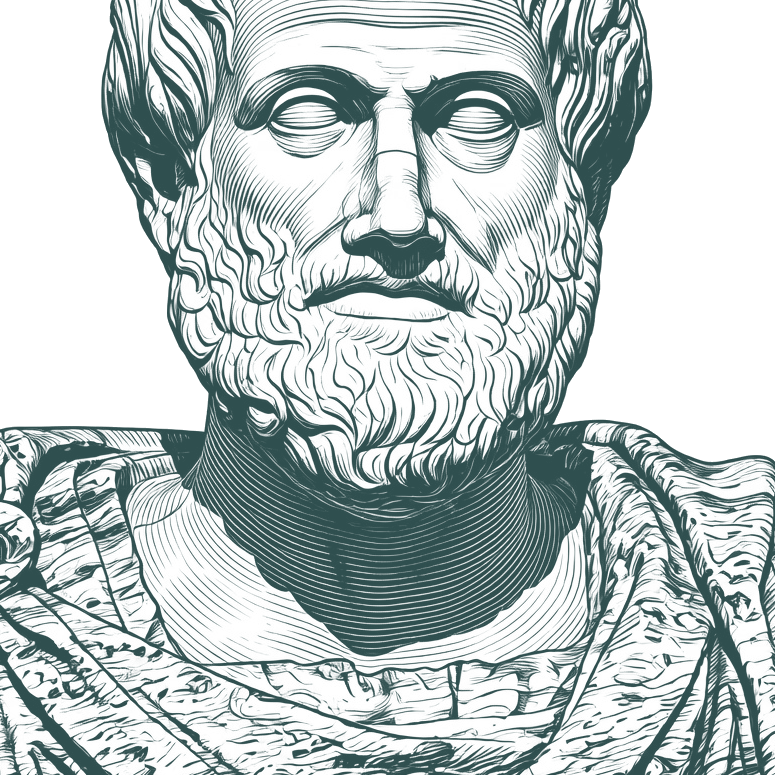
Aristotle (Ἀριστοτέλης Aristotelēs; 384 BC – 322 BC) was a Greek philosopher and polymath during the Classical period in Ancient Greece. Taught by Plato, he was the teacher of Theophrastus and founder of the Lyceum, the Peripatetic school of philosophy, and the Aristotelian tradition. His writings cover many subjects including physics, biology, zoology, metaphysics, logic, ethics, aesthetics, poetry, theatre, music, rhetoric, psychology, linguistics, economics, politics, meteorology, geology and government. Aristotle provided a complex synthesis of the various philosophies existing prior to him. It was above all from his teachings that the West inherited its intellectual lexicon, as well as problems and methods of inquiry. As a result, his philosophy has exerted a unique influence on almost every form of knowledge in the West and it continues to be a subject of contemporary philosophical discussion.
Biography information from
Wikiquote·
Portrait adapted from
Wikimedia Commons, After Lysippos (Public domain / CC0)
Also Known As
Native Name:
Ἀριστοτέλης
Alternative Names:
the Stagirite
•
Aristotelis
•
Aristoteles
First then this must be noted, that it is the nature of such things to be spoiled by defect and excess; as we see in the case of health and strength (since for the illustration of things which cannot be seen we must use those that can), for excessive training impairs the strength as well as deficient: meat and drink, in like manner, in too great or too small quantities, impair the health: while in due proportion they cause, increase, and preserve it.
But it is better perhaps to examine next the universal good, and to enquire in what sense the expression is used. Though such an investigation is likely to be difficult, because the persons who have introduced these ideas are our friends. Yet it will perhaps appear the best, and indeed the right course, at least for the preservation of truth, to do away with private feelings, especially as we are philosophers; for since both are dear to us, we are bound to prefer the truth. (Bk. 1, Chapter III)
The life of active virtue is essentially pleasant.