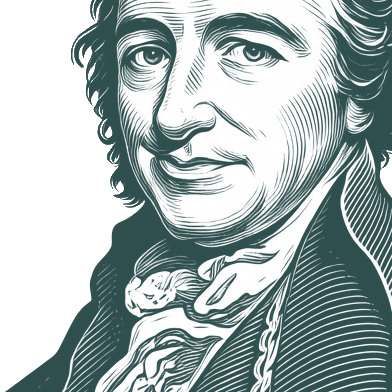
Thomas Paine (February 9, 1737 [O.S. January 29, 1736] – 8 June 1809) was a British-American political writer, theorist, and activist who had a great influence on the thoughts and ideas which led to the American Revolution and the United States Declaration of Independence. He wrote three of the most influential and controversial works of the 18th Century: Common Sense, Rights of Man, and The Age of Reason. His ideas reflected Enlightenment-era ideals of transnational human rights.
Biography information from
Wikiquote·
Portrait adapted from
Wikimedia Commons, Auguste Millière / After George Romney / After William Sharp (Public domain / CC0)
Portrait from Wikimedia Commons. Credit: Auguste Millière / After George Romney / After William Sharp. Used under Public domain / CC0. Processed and styled by Quotewise.
Unlimited Quote Collections
Organize your favorite quotes without limits. Create themed collections for every occasion with Premium.
It is to be observed throughout Mr. Burke's book that he never speaks of plots against the Revolution; and it is from those plots that all the mischiefs have arisen. It suits his purpose to exhibit the consequences without their causes. It is one of the arts of the drama to do so. If the crimes of men were exhibited with their sufferings, stage effect would sometimes be lost, and the audience would be inclined to approve where it was intended they should commiserate.
It is painful to behold a man employing his talents to corrupt himself. Nature has been kinder to Mr. Burke than he is to her. He is not affected by the reality of distress touching his heart, but by the showy resemblance of it striking his imagination. He pities the plumage, but forgets the dying bird.
The great Question may be—What should be done with those who are enslaved already? To turn the old and infirm free, would be injustice and cruelty; they who enjoyed the labours of their better days should keep, and treat them humanely. As to the rest, let prudent men, with the assistance of legislatures, determine what is practicable for masters, and best for them. Perhaps some could give them lands upon reasonable rent, some, employing them in their labour still, might give them some reasonable allowances for it; so as all may have some property, and fruits of their labours at their own disposal, and be encouraged to industry; the family may live together, and enjoy the natural satisfaction of exercising relative affections and duties, with civil protection, and other advantages, like fellow men. Perhaps they might sometime form useful barrier settlements on the frontiers. Thus they may become interested in the public welfare, and assist in promoting it; instead of being dangerous, as now they are, should any enemy promise them a better condition.