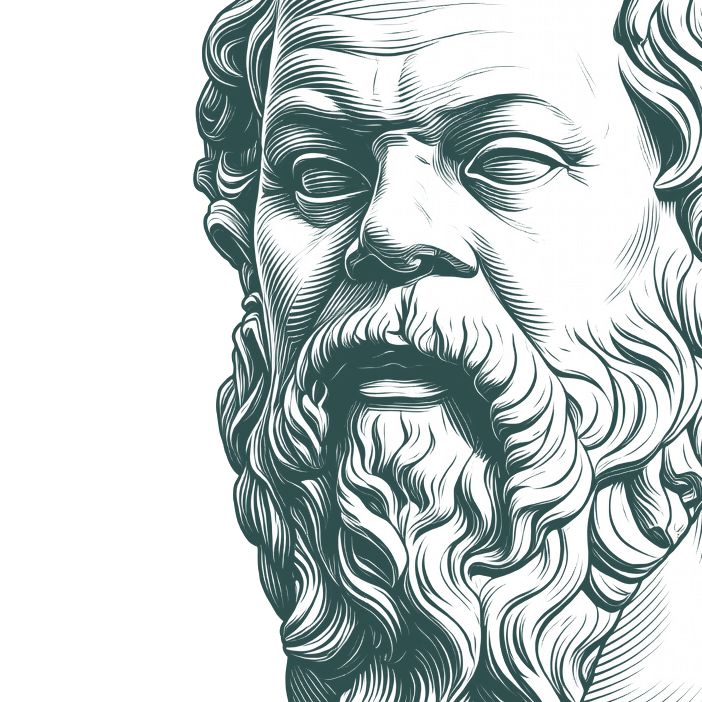
Socrates (Σωκράτης; c. 470 BC – 399 BC) was a classical Greek (Athenian) philosopher credited as one of the founders of Western philosophy. Through his portrayal in Plato's dialogues, Socrates has become renowned for his contribution to the field of ethics, and it is this Platonic Socrates who lends his name to the concepts of Socratic irony and the Socratic method, or elenchus. The latter remains a commonly used tool in a wide range of discussions, and is a type of pedagogy in which a series of questions is asked not only to draw individual answers, but also to encourage fundamental insight into the issue at hand.
Biography information from
Wikiquote·
Portrait adapted from
Wikimedia Commons, Copy of Lysippos (?) (Public domain / CC0)
Let us... be careful of admitting into our souls the notion that there is no truth or health or soundness in any arguments at all; but let us rather say that there is as yet no health in us, and that we must quit ourselves like men and do our best to gain health—you and all other men with a view to the whole of your future life, and I myself with a view to death.
PREMIUM FEATURE
Advanced Search Filters
Filter search results by source, date, and more with our premium search tools.
For this fear of death is indeed the pretense of wisdom, and not real wisdom, being the appearance of knowing the unknown; since no one knows whether death, which they in their fear apprehend to be the greatest evil, may not be the greatest good. Is there not here conceit of knowledge, which is a disgraceful sort of ignorance? And this is the point in which, as I think, I am superior to men in general, and in which I might perhaps fancy myself wiser than other men, - that whereas I know but little of the world below, I do not suppose that I know: but I do know that injustice and disobedience to a better, whether God or man, is evil and dishonorable, and I will never fear or avoid a possible good rather than a certain evil.