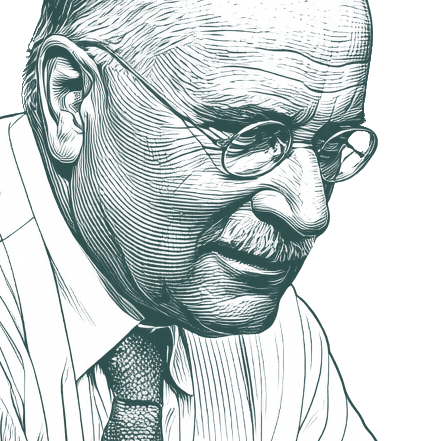
Why is psychology the youngest of the empirical sciences? Why have we not long since discovered the unconscious and raised up its treasure-house of e… - Carl Jung
""
Why is psychology the youngest of the empirical sciences? Why have we not long since discovered the unconscious and raised up its treasure-house of eternal images? Simply because we had a religious formula for everything psychic — and one that is far more beautiful and comprehensive than immediate experience. Though the Christian view of the world has paled for many people, the symbolic treasure-rooms of the East are still full of marvels that can nourish for a long time to come the passion for show and new clothes. What is more, these images — be they Christian or Buddhist or what you will — are lovely, mysterious, richly intuitive.
English
Collect this quote
About
Carl Jung
Carl Gustav Jung (IPA: [ˈkarl ˈgʊstaf ˈjʊŋ]) (26 July 1875 – 6 June 1961) was a Swiss psychiatrist and founder of analytical psychology.
Biography information from
Wikiquote·
Portrait adapted from
Wikimedia Commons, Unbekannt (Public domain / CC0)
Also Known As
Alternative Names:
C.G. Jung
•
Karl Gustav Jung
•
C. G. Jung
•
C. G. Yungu
•
Carl Gustav Jung
•
Jung
But there is no energy unless there is a tension of opposites; hence it is necessary to discover the opposite to the attitude of the conscious mind.
People will do anything, no matter how absurd, in order to avoid facing their own souls. They will practice Indian yoga and all its exercises, observe a strict regimen of diet, learn the literature of the whole world—all because they cannot get on with themselves and have not the slightest faith that anything useful could ever come out of their own souls. Thus the soul has gradually been turned into a Nazareth from which nothing good can come.
Every emotional state produces an alteration of consciousness which Janet called abaissement du niveau mental; that is to say there is a certain narrowing of consciousness and a corresponding strengthening of the unconscious which, particularly in the case-of strong affects, is noticeable even to the layman.