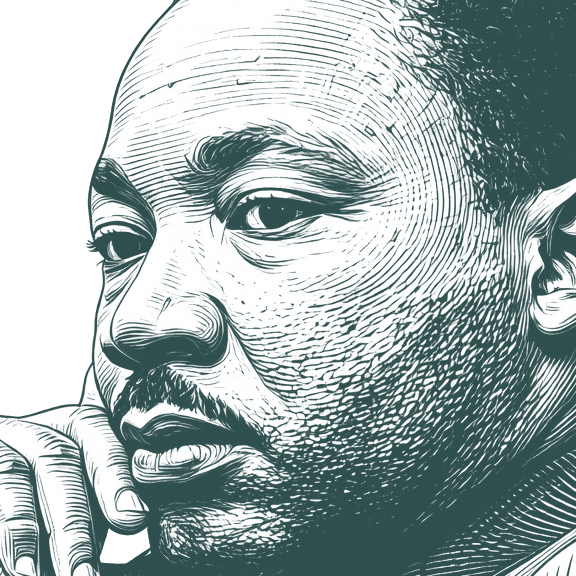
The third way open to oppressed people in their quest for freedom is the way of nonviolent resistance. Like the synthesis in Hegelian philosophy, the… - Martin Luther King Jr.
""
The third way open to oppressed people in their quest for freedom is the way of nonviolent resistance. Like the synthesis in Hegelian philosophy, the principle of nonviolent resistance seeks to reconcile the truths of two opposites, acquiescence and violence, while avoiding the extremes and immoralities of both. The nonviolent resister agrees with the person who acquiesces that one should not be physically aggressive toward his opponent; but he balances the equation by agreeing with the person of violence that evil must be resisted. He avoids the nonresistance of the former and the violent resistance of the latter. With nonviolent resistance, no individual or group need submit to any wrong, nor need anyone resort to violence in order to right a wrong.
Dr. Martin Luther King Jr. (15 January 1929 – 4 April 1968) was an American Baptist minister, civil rights activist, and recipient of the Nobel Peace Prize of 1964. He was the husband of Coretta Scott King, and father of Yolanda King and Martin Luther King III.
Biography information from
Wikiquote·
Portrait adapted from
Wikimedia Commons, Yoichi Okamoto (Public domain / CC0)
Also Known As
Birth Name:
Michael King Jr.
Alternative Names:
Martin Luther King, Jr.
•
Dr. Martin Luther King, Jr.
•
Martin Luther King
•
Michael King
•
Dr. King
•
M. L. King
•
M.L. King
•
ML King
•
MLK
•
Martin Luther King Junior
•
Michael King Junior
•
Rev. Dr. Martin Luther King Jr.
•
The Rev. Dr. Martin Luther King Jr.
In our glorious fight for civil rights, we must guard against being fooled by false slogans, such as "right to work." It is a law to rob us of our civil rights and job rights. It is supported by Southern segregationists who are trying to keep us from achieving our civil rights and our right of equal job opportunity. Its purpose is to destroy labor unions and the freedom of collective bargaining by which unions have improved wages and working conditions of everyone...Wherever these laws have been passed, wages are lower, job opportunities are fewer and there are no civil rights. We do not intend to let them do this to us. We demand this fraud be stopped. Our weapon is our vote.