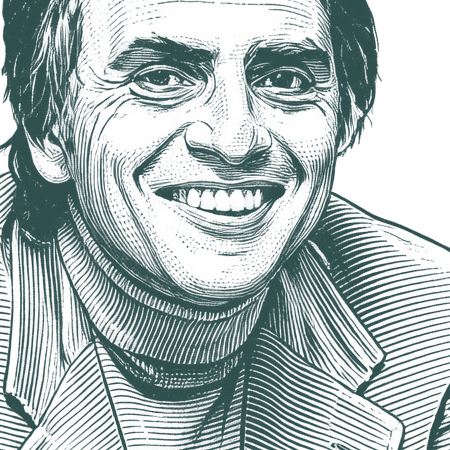
But when I talk to high school seniors, I find something different. They memorize 'facts'. By and large, though, the joy of discovery, the life behin… - Carl Sagan
""
But when I talk to high school seniors, I find something different. They memorize 'facts'. By and large, though, the joy of discovery, the life behind those facts, has gone out of them. They've lost much of the wonder, and gained very little scepti-cism. They're worried about asking 'dumb' questions; they're willing to accept inadequate answers; they don't pose follow-up questions; the room is awash with sidelong glances to judge, second-by-second, the approval of their peers. They come to class with their questions written out on pieces of paper, which they surreptitiously examine, waiting their turn and oblivious of what-ever discussion their peers are at this moment engaged in.
English
Collect this quote
About
Carl Sagan
Carl Edward Sagan (9 November 1934 – 20 December 1996) was an American astronomer, planetary scientist, cosmologist, astrophysicist, astrobiologist, author, and science communicator. His best known scientific contribution is research on extraterrestrial life, including experimental demonstration of the production of amino acids from basic chemicals by radiation. Sagan assembled the first physical messages sent into space, the Pioneer plaque and the Voyager Golden Record, universal messages that could potentially be understood by any extraterrestrial intelligence that might find them. Sagan argued the hypothesis, accepted since, that the high surface temperatures of Venus can be attributed to, and calculated using, the greenhouse effect. He testified to the US Congress in 1985 that the greenhouse effect will change the earth's climate system.
Biography information from
Wikiquote·
Portrait adapted from
Wikimedia Commons, NASA/JPL (Public domain / CC0)
Also Known As
Native Name:
Carl Edward Sagan
Alternative Names:
Sagan
•
Carl E. Sagan
•
Carl E Sagan
•
C. E. Sagan
•
C.E. Sagan
•
C E Sagan
•
C. Sagan
•
C Sagan
•
Sagan C
•
Sagan C.
•
Sagan C. E.
•
Sagan CE
Saat ini kita tahu ada 8 planet (plus Matahari, jadi 9 benda utama di pusat sistem kita). Tapi orang zaman kuno tidak tahu itu.
Alasannya sederhana: teknologi dan perspektif.
Berikut adalah 7 benda langit yang mereka maksud, dan mengapa hanya tujuh: Orang zaman kuno hanya bisa mengamati langit dengan mata telanjang. Dari perspektif mereka di Bumi, mereka melihat ribuan titik cahaya (bintang). Namun, mereka menyadari ada tujuh di antara titik-titik cahaya itu yang "berperilaku" aneh. Sementara bintang-bintang lain posisinya tetap (membentuk konstelasi seperti Orion atau Scorpio), ketujuh benda ini bergerak atau "mengembara" di antara bintang-bintang tetap itu.Inilah ketujuh "pengelana" itu: Matahari Bulan Mars Merkurius Jupiter Venus Saturnus
Ketujuh benda inilah yang paling terang dan terlihat bergerak dari hari ke hari, sehingga dianggap istimewa dan memiliki kekuatan dewa. Kata "planet" sendiri berasal dari bahasa Yunani planētēs, yang artinya "pengembara".
Lalu, Mengapa Benda Lain Tidak Termasuk?
Bumi: Orang kuno tidak menganggap Bumi sebagai planet. Bagi mereka, Bumi adalah pusat dari segalanya, tempat mereka berpijak. Mereka melihat benda-benda langit bergerak mengelilingi Bumi, bukan Bumi yang bergerak mengelilingi Matahari.
Uranus & Neptunus: Keduanya terlalu jauh dan terlalu redup untuk bisa dilihat dengan mata telanjang. Uranus baru ditemukan pada tahun 1781 dan Neptunus pada tahun 1846, keduanya setelah penemuan teleskop.Pluto (dan planet kerdil lainnya): Jauh lebih kecil dan lebih jauh lagi, baru ditemukan pada abad ke-20. *** Konsep "7 hari, 7 planet, 7 dewa" sudah ada ribuan tahun sebelum kita tahu tentang Uranus dan Neptunus."
Our history is in part a battle to the death of inadequate myths. If I can't convince you, I must kill you. That will change your mind. You are a threat to my version of the truth, especially the truth about who I am and what my nature is. The thought that I may have dedicated my life to a lie, that I might have accepted a conventional wisdom that no longer, if it ever did, corresponds to the external reality, that is a very painful realization. I will tend to resist it to the last. I will go to almost any lengths to prevent myself from seeing that the worldview that I have dedicated my life to is inadequate.
Go Premium
Support Quotewise while enjoying an ad-free experience and premium features.
«قد يجادل أحد، بأن الدجلنة يجري اعتناقها على نحو يتناسب طرديًا وبدقة مع عدم فهم العلم الحقيقي فإذا كنت لم تسمع عن العلم مطلقًا (ناهيك عن الطريقة التي يسير بها)، فستكون بالكاد قادرًا على الوعي بأنك تعتنق الدجلنة. وما تفعله ببساطة هو التفكير بإحدى الطرق التي يُفكر بها البشر دائمًا. فالأديان غالبًا ما تكون بمثابة الحضانات التي تحميها الدولة كي تترعرع داخلها الدجلنة، رغم عدم وجود سبب يضطر الدين إلى لعب هذا الدور. فهذا الدور إلى حد ما شيء اصطنعه الإنسان منذ عصور موغلة في القدم. ففي بعض البلاد، يعتقد الجميع، تقريبًا، في التنجيم والمعرفة المسبقة بالأحداث، بما في ذلك زعماء الحكومات. غير أن هذا لم يقحم على عقولهم ببساطة بفعل الدين، وإنما هذا الإيمان بالتنجيم مستمد من الثقافة المحيطة التي يستريح فيها الجميع إلى هذه الممارسات، والشواهد التي تؤكد ذلك توجد في كل مكان.»