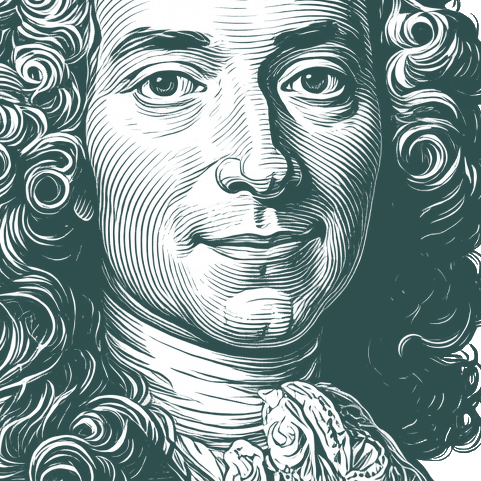
You have already heard that the Quakers date their epoch from Christ, who, according to them, was the first Quaker. Religion, say they, was corrupted… - Voltaire
""
You have already heard that the Quakers date their epoch from Christ, who, according to them, was the first Quaker. Religion, say they, was corrupted almost immediately after His death, and remained in that state of corruption about sixteen hundred years. But there were always a few of the faithful concealed in the world, who carefully preserved the sacred fire, which was extinguished in all but themselves; till at length this light shone out in England in 1642. It was at the time when Great Britain was distracted by intestine wars, which three or four sects had raised in the name of God, that one George Fox, a native of Leicestershire, and son of a silk-weaver, took it into his head to preach the Word, and, as he pretended, with all the requisites of a true apostle; that is, without being able either to read or write. He was a young man, about twenty-five years of age, of irreproachable manners, and religiously mad. He was clad in leather from head to foot, and travelled from one village to another, exclaiming against the war and the clergy.
English
Collect this quote
About
Voltaire
François-Marie Arouet (21 November 169430 May 1778), known by his nom de plume Voltaire, was a French Enlightenment writer, philosopher (philosophe), satirist, and historian. Famous for his wit and his criticism of Christianity (especially of the Roman Catholic Church) and of slavery, Voltaire was an advocate of freedom of speech, freedom of religion, and separation of church and state. Voltaire was a versatile and prolific writer, producing works in almost every literary form, including plays, poems, novels, essays, histories, and even scientific expositions. He wrote more than 20,000 letters and 2,000 books and pamphlets. Voltaire was one of the first authors to become renowned and commercially successful internationally. He was an outspoken advocate of civil liberties and was at constant risk from the strict censorship laws of the Catholic French monarchy. His polemics witheringly satirized intolerance and religious dogma, as well as the French institutions of his day. His best-known work and magnum opus, Candide, is a novella that comments on, criticizes, and ridicules many events, thinkers and philosophies of his time, most notably Gottfried Leibniz and his belief that our world is of necessity the "best of all possible worlds".
Biography information from
Wikipedia·
Portrait adapted from
Wikimedia Commons, Nicolas de Largillière (Public domain / CC0)
Also Known As
Pen Names:
Bénédictin
Alternative Names:
Dictador de letras
•
François-Marie Arouet
•
François Marie Arouet
•
Benedictina