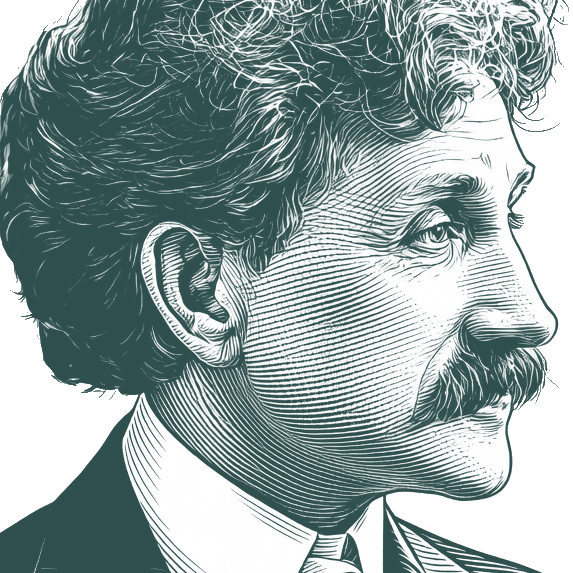
To take the life of an ox for his muscles, or to kill a sheep for his skin is murder, and those who do these things or cause them to be done are murd… - J. Howard Moore
""
To take the life of an ox for his muscles, or to kill a sheep for his skin is murder, and those who do these things or cause them to be done are murderers just as actually as highwaymen are who blow off the heads of hapless wayfarers for their guineas. If these things seem untrue it is not because they are untrue, but because those to whom they seem so are unable to judge conduct from the quadrupedal point of view.
John Howard Moore (December 4, 1862 – June 17, 1916) was an American zoologist, philosopher, educator and social reformer. He advocated for the ethical consideration and treatment of animals and authored several articles, books, essays and pamphlets on topics including education, ethics, evolutionary biology, humanitarianism, utilitarianism and vegetarianism. He is best known for his work The Universal Kinship (1906), which advocated for a secular sentiocentric philosophy he called the doctrine of "Universal Kinship", based on the shared evolutionary kinship between all sentient beings.
The inhabitants of the earth are bound to each other by the ties and obligations of a common kinship. Man is simply one of a series of sentients, differing in degree, but not in kind, from the beings below, above, and around him.
From the standpoint of economy alone, the diet of the fields and orchards ought to appeal successfully to every one possessed of undoubted sanity. One acre devoted to wheat will support ten times as many men as one devoted to grazing. If men would take the beautiful products of the soil fresh from Nature's hand, instead of sitting down and devouring, in the form of the accumulated residuum or ruminants^ an acre at a meal, the problems o human poverty and over-population would be immensely simplified.
Works in ChatGPT, Claude, or Any AI
Add semantic quote search to your AI assistant via MCP. One command setup.
I came to the conclusion out there on the Kansas prairies that the animals were not treated right by human beings. I thought we had not even a right to kill them for food and came to the University of Chicago to study the matter. At that time I had never heard of vegetarianism.