Do we want to contemplate his power? We see it in the immensity of the Creation. Do we want to contemplate his wisdom? We see it in the unchangeable … - Thomas Paine
""
Do we want to contemplate his power? We see it in the immensity of the Creation. Do we want to contemplate his wisdom? We see it in the unchangeable order by which the incomprehensible whole is governed! Do we want to contemplate his munificence? We see it in the abundance with which he fills the earth. Do we want to contemplate his mercy? We see it in his not withholding that abundance even from the unthankful. In fine, do we want to know what God is? Search not the book called the Scripture, which any human hand might make, but the Scripture called the Creation.
English
Collect this quote
About
Thomas Paine
Thomas Paine (February 9, 1737 [O.S. January 29, 1736] – 8 June 1809) was a British-American political writer, theorist, and activist who had a great influence on the thoughts and ideas which led to the American Revolution and the United States Declaration of Independence. He wrote three of the most influential and controversial works of the 18th Century: Common Sense, Rights of Man, and The Age of Reason. His ideas reflected Enlightenment-era ideals of transnational human rights.
Biography information from
Wikiquote·
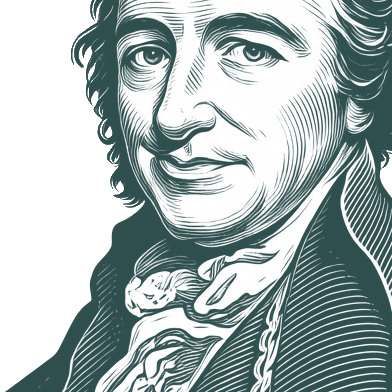
Portrait adapted from
Wikimedia Commons, Auguste Millière / After George Romney / After William Sharp (Public domain / CC0)
Portrait from Wikimedia Commons. Credit: Auguste Millière / After George Romney / After William Sharp. Used under Public domain / CC0. Processed and styled by Quotewise.
Works in ChatGPT, Claude, or Any AI
Add semantic quote search to your AI assistant via MCP. One command setup.
In fine, do we want to know what God is? Search not the book called the Scripture, which any human hand might make, but the Scripture called the Creation.
Do we want to contemplate his wisdom? We see it in the unchangeable order by which the incomprehensible whole is governed.
Do we want to contemplate his mercy? We see it in his not withholding that abundance, even from the unthankful.
The word mystery cannot be applied to moral truth, any more than obscurity can be applied to light. The God in whom we believe is a God of moral truth, and not a God of mystery or obscurity. Mystery is the antagonist of truth. It is a fog of human invention that obscures truth, and represents it in distortion. Truth never envelops itself in mystery; and the mystery in which it is at any time enveloped, is the work of its antagonist, and never of itself.
Religion, therefore, being the belief of a God, and the practice of a moral truth, cannot have connection with mystery.
Later times have laid all the blame upon the Goths and Vandals; but, however unwilling the partisans of the Christian system may be to believe or to acknowledge it, it is nevertheless true that the age of ignorance commenced with the Christian system.
Works in ChatGPT, Claude, or Any AI
Add semantic quote search to your AI assistant via MCP. One command setup.
Men who look upon themselves born to reign, and others to obey, soon grow insolent; selected from the rest of mankind their minds are early poisoned by importance; and the world they act in differs so materially from the world at large, that they have but little opportunity of knowing its true interests, and when they succeed to the government are frequently the most ignorant and unfit of any throughout the dominions.