By this, then, we will know both what we ought to subtract from the person who has the greater share and what we ought to add to him who has the less… - Aristotle
""
By this, then, we will know both what we ought to subtract from the person who has the greater share and what we ought to add to him who has the lesser: we ought to add that which exceeds the middle term to the person with the lesser, and to subtract from the one who has the greatest that by which the middle term is exceeded. The lines αα′, ββ′, γγ′ beingequal to one another, subtract from αα′ the part αε and add it to γγ′ as part, so that the whole, δγγ′, exceeds εα′ by δγ and γζ, and hence ββ′ by δγ.18
English
Collect this quote
About
Aristotle
Aristotle (Ἀριστοτέλης Aristotelēs; 384 BC – 322 BC) was a Greek philosopher and polymath during the Classical period in Ancient Greece. Taught by Plato, he was the teacher of Theophrastus and founder of the Lyceum, the Peripatetic school of philosophy, and the Aristotelian tradition. His writings cover many subjects including physics, biology, zoology, metaphysics, logic, ethics, aesthetics, poetry, theatre, music, rhetoric, psychology, linguistics, economics, politics, meteorology, geology and government. Aristotle provided a complex synthesis of the various philosophies existing prior to him. It was above all from his teachings that the West inherited its intellectual lexicon, as well as problems and methods of inquiry. As a result, his philosophy has exerted a unique influence on almost every form of knowledge in the West and it continues to be a subject of contemporary philosophical discussion.
Biography information from
Wikiquote·
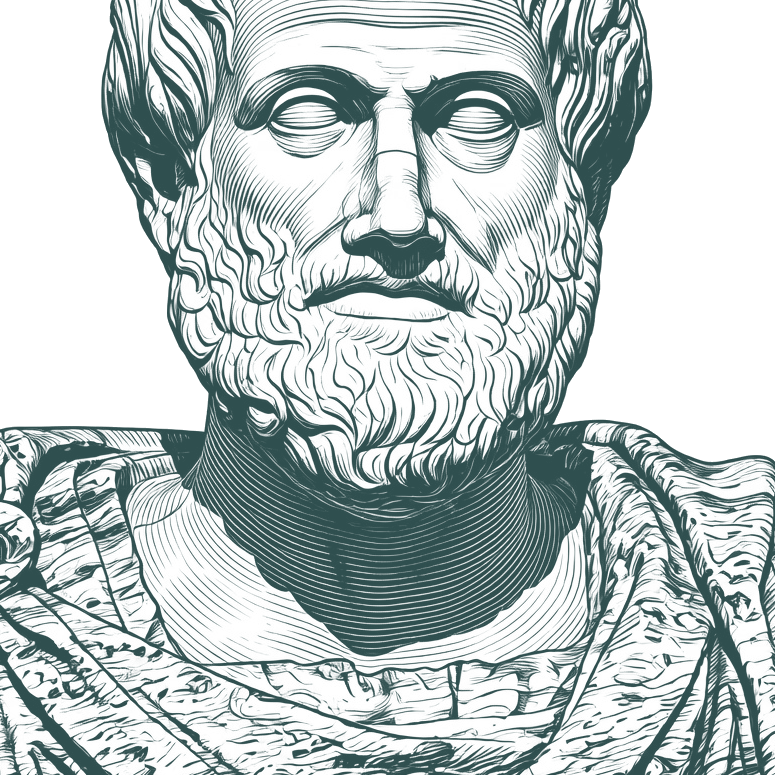
Portrait adapted from
Wikimedia Commons, After Lysippos (Public domain / CC0)
Also Known As
Native Name:
Ἀριστοτέλης
Alternative Names:
the Stagirite
•
Aristotelis
•
Aristoteles
As for the life of money-making, it is one of constraint, and wealth is manifestly not the good of which we are in search, for it is only useful as a means to something else, and for this reason there is less to be said for it than for the ends mentioned before, which are, at any rate, desired for their own sakes. (Bk. 1, Chapter III)
Unlimited Quote Collections
Organize your favorite quotes without limits. Create themed collections for every occasion with Premium.