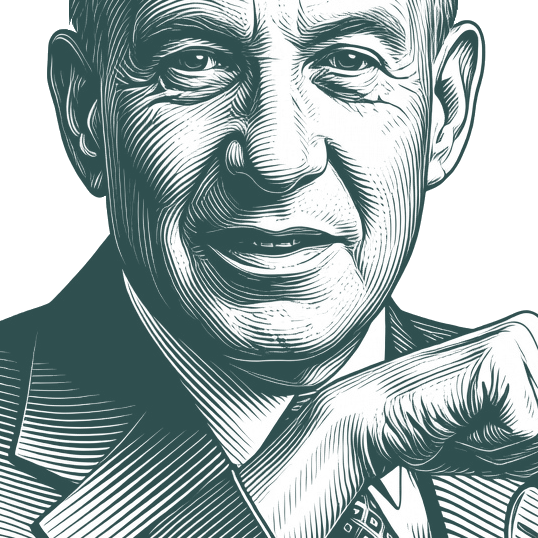
The job is, however, not to set priorities. That is easy. Everybody can do it. The reason why so few executives concentrate is the difficulty of sett… - Peter Drucker
""
The job is, however, not to set priorities. That is easy. Everybody can do it. The reason why so few executives concentrate is the difficulty of setting “posteriorities” — that is, deciding what tasks not to tackle — and of sticking to the decision.
English
Collect this quote
About
Peter Drucker
Peter Ferdinand Drucker (November 19 1909 – November 11 2005) was an Austrian-born American writer, management consultant and university professor. In 1943 he became a naturalized citizen of the United States. He taught at New York University and Claremont Graduate University respectively.
In addition, profits are so completely subordinated in Germany and Italy to requirements of a militarily conceived national interest and of full employment that the maintenance of the profit principle is purely theoretical. Profits have lost their autonomy as an independent, not to say the supreme, goal of economic activity.
Strong decision makers often put somebody they trust into the number two spot as their adviser — and in that position the person is outstanding. But in the number one spot, the same person fails. He or she knows what the decision should be but cannot accept the responsibility of actually making it.
Try QuoteGPT
Chat naturally about what you need. Each answer links back to real quotes with citations.
For the existing enterprise, whether business or public-service institution, the controlling word in the term ‘entrepreneurial management’ is ‘entrepreneurial’. For the new venture, it is ‘management’. In the existing business, it is the existing that is the main obstacle to entrepreneurship. In the new venture, it is its absence. The new venture has an idea. It may have a product or a service. It may even have sales, and sometimes quite a substantial volume of them. It surely has costs. And it may have revenues and even profits. What it does not have is a ‘business’, a viable, operating, organized ‘present’ in which people know where they are going, what they are supposed to do, and what the results are or should be. But unless a new venture develops into a new business and makes sure of being ‘managed’, it will not survive no matter how brilliant the entrepreneurial idea, how much money it attracts, how good its products, nor even how great the demand for them.