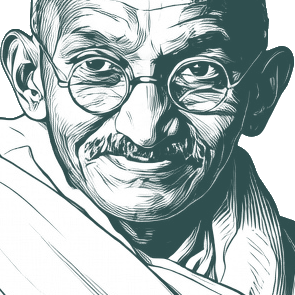
In reality there are as many religions as there are individuals.... Religions are different roads converging to the same point. What does it matter t… - Mahatma Gandhi
""
In reality there are as many religions as there are individuals.... Religions are different roads converging to the same point. What does it matter that we take different roads, so long as we reach the same goal. Wherein is the cause for quarreling?
English
Collect this quote
About
Mahatma Gandhi
Mohandas Karamchand Gandhi (2 October 1869 – 30 January 1948) was an Indian lawyer, anti-colonial nationalist and political ethicist who employed nonviolent resistance to lead the successful campaign for India's independence from British rule, and to later inspire movements for civil rights and freedom across the world. The honorific Mahātmā (Sanskrit: "great-souled", "venerable"), first applied to him in 1914 in South Africa, is now used throughout the world.
Biography information from
Wikiquote·
Portrait adapted from
Wikimedia Commons, Elliott & Fry (Public domain / CC0)
Also Known As
Native Name:
મોહનદાસ ગાંધી
Alternative Names:
M. K. Gandhi
•
Mohandas K Gandhi
•
M K Gandhi
•
Mohandas Gandhi
•
Gandhi
•
Mohandas K. Gandhi
•
Gandhiji
•
Bapuji
•
Father of the Nation
•
Bapu
•
Mahatma Mohandas Karamchand Gandhi
•
Mohandas Karamchand Gandhi
•
MK Gandhi
To forget how to dig the earth and to tend the soil is to forget ourselves.
[During his prayer meeting on 1 May 1947, he prepared the Hindus and Sikhs for the anticipated massacres of their kind in the upcoming state of Pakistan with these words:] ‘I would tell the Hindus to face death cheerfully if the Muslims are out to kill them. I would be a real sinner if after being stabbed I wished in my last moment that my son should seek revenge. I must die without rancour. (…) You may turn round and ask whether all Hindus and all Sikhs should die. Yes, I would say. Such martyrdom will not be in vain.’
There was a time when people listened to me because I showed them how to give fight to the British without arms when they had no arms and the British Government was fully equipped and organised for an armed fight. But today I am told that my non-violence can be of no avail against the communal madness and, therefore, people should arm themselves for self-defence. If this is true, it has to be admitted that our thirty years of nonviolent practice was an utter waste of time. We should have from the beginning trained ourselves in the use of arms. But I do not agree that our thirty years' probation in nonviolence has been utterly wasted. It was due to our non-violence, defective though it was, that we were able to bear up under the heaviest repression and the message of independence penetrated every nook and corner of India. But as our non-violence was the nonviolence of the weak, the leaven did not spread. Had we adopted non-violence as the weapon of the strong, because we realised that it was more effective than any other weapon, in fact the mightiest force in the world, we would have made use of its full potency and not have discarded it as soon as the fight against the British was over or we were in a position to wield conventional weapons. But as I have already said, we adopted it out of our helplessness. If we had the atom bomb, we would have used it against the British.