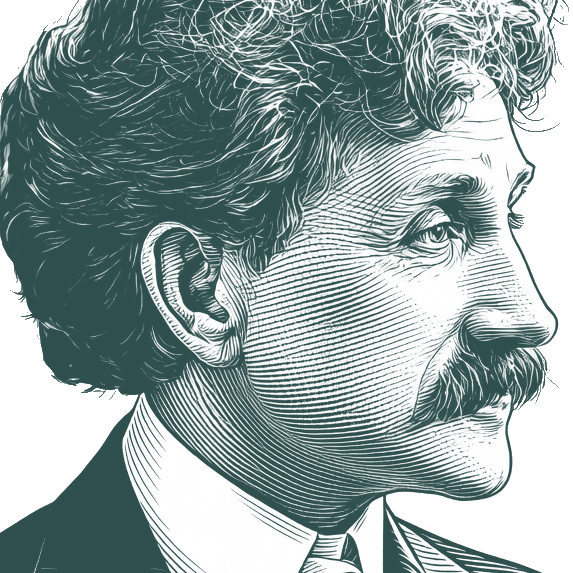
This man, our brother, never purposely killed a living thing until he put the pistol to his head. Poor dead dreamer, you are not the first or last mo… - J. Howard Moore
""
This man, our brother, never purposely killed a living thing until he put the pistol to his head. Poor dead dreamer, you are not the first or last mortal to learn the truth [...] I have dreamed my dreams, had my illusions and wakened from my sleep. Why do I not follow him? I do not end it all because the love of life and the shrinking fear of death in all living things stays my hand and my courage fails.
John Howard Moore (December 4, 1862 – June 17, 1916) was an American zoologist, philosopher, educator and social reformer. He advocated for the ethical consideration and treatment of animals and authored several articles, books, essays and pamphlets on topics including education, ethics, evolutionary biology, humanitarianism, utilitarianism and vegetarianism. He is best known for his work The Universal Kinship (1906), which advocated for a secular sentiocentric philosophy he called the doctrine of "Universal Kinship", based on the shared evolutionary kinship between all sentient beings.
Why should living beings struggle against each other, except as they struggle to advance the general welfare? Happiness is just as valuable and just as beautiful a thing in one being as in another. Some have greater talent for it than have others but it is a state of sweetness and elation always and everywhere. And each living being, in deliberating on the problem of the proprieties, should realize the fact that, as a matter of fact, it is a matter of indifference whether this relation belongs to his sensorium or to some other sensorium. It is insane for each being to insist that he, as an organism, is the one organism to whom pleasure is indispensable. The only indispensable is that pleasure be maximized. If a definite amount of happiness is to be experienced, it is, in the eyes of the absolute, a matter of indifference whether this happiness is experienced by one individual or by another, by self or by some other conscious portion of the universe.
It is not possible, and it never will be possible, to organize all the beings occupying space into one immense confederacy. This would be ideal, but from the inexorable nature of things it can never be. The denizens of the sea depths can not correlate with the inhabitants of the clouds. The lion can not fraternize with the lamb, nor the hawk with the sparrow. The natures of beings have been evolved thru war, and they are in large part irredeemably antagonistic. But the approximation, if honest, may be more successful than is supposed, and may include many species not human. The bird may contribute his song and plumage, the sheep his fleece, the horse, the ox, the elephant, and the camel their strength or speed, the cow and the fowl their secretions, the dog his fidelity, and man his art. The ultimate and ideal aggregation of the living universe will not be a pan-American union nor a Euro-American league, nor even an aggregation whose spirit is embodied in a parliament of man, but the widest and most consummate possible Confederation of the Consciousnesses.
The great trouble is that individuals and races in their treatment of each other are not guided by the same high standards of impartiality as an individual organism in dealing with his own organs and parts. Life is not one. It lacks unity of feeling and purpose. And as long as it lacks this oneness it will lack justice.