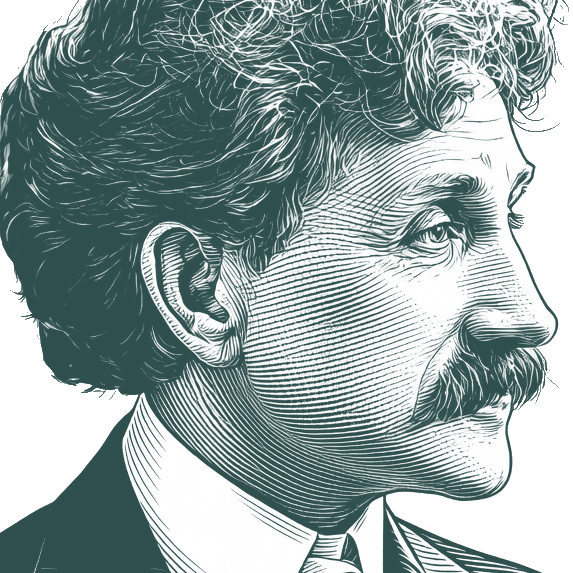
Man, in satisfying his desires, in avoiding misery and achieving happiness, strives to do two things with the inanimate universe: to manage it and to… - J. Howard Moore
""
Man, in satisfying his desires, in avoiding misery and achieving happiness, strives to do two things with the inanimate universe: to manage it and to foreknow it. The inanimate is not devoted to us. We are not birdlings cuddled in an order of things where we need simply to yawn and be filled. We must bestir ourselves, or be in a position to compel others to bestir themselves for us, or perish. We are waifs, brought into existence by a universe whose solicitude for us ended with the travail that brought us forth. The inanimate universe is our mother, but without the blessed mother-love. The first thing we are conscious of, and about the only thing we ever absolutely know, is that we are whirling around in a very helpless manner on a whirligig of a ball, out of whose substance by the sweat of our brows we must quarry our existence. The universe is practically independent of us. But we, alas, are not independent of it. The food we eat, our raiment, our habitations, our treasures, our implements of knowledge, and our means of amusement are all portions of the inanimate, which we living beings must somehow subtract from the rest. In order to obtain these indispensable portions of the universe about us, we must halter it and control it and compel it to produce to the tune of our desires.
English
Collect this quote
About
J. Howard Moore
John Howard Moore (December 4, 1862 – June 17, 1916) was an American zoologist, philosopher, educator and social reformer. He advocated for the ethical consideration and treatment of animals and authored several articles, books, essays and pamphlets on topics including education, ethics, evolutionary biology, humanitarianism, utilitarianism and vegetarianism. He is best known for his work The Universal Kinship (1906), which advocated for a secular sentiocentric philosophy he called the doctrine of "Universal Kinship", based on the shared evolutionary kinship between all sentient beings.
Act toward others as you would act toward a part of your own self.
Man is a talkative and religious ape. He is an ape, but with a much greater amount of enterprise and with a greater likelihood of being found in every variety of climate. Like the anthropoid, man has a bald face and an obsolete tail. But he is distinguished from his arboreal relative by his arrogant bearing, his skilled larynx, and especially by the satisfaction he experiences in the contemplation of the image which appears when he looks in a mirror.
PREMIUM FEATURE
Advanced Search Filters
Filter search results by source, date, and more with our premium search tools.
The universe is an evolution. Change is as extensive as time and space. The present has come out of that which has been, and will enter into and determine that which is to be. Everything has a biography. Everything has evolved—everything—from the murmur on the lips of the speechless babe to the soul of the poet, and from the molecule to Jehovah.