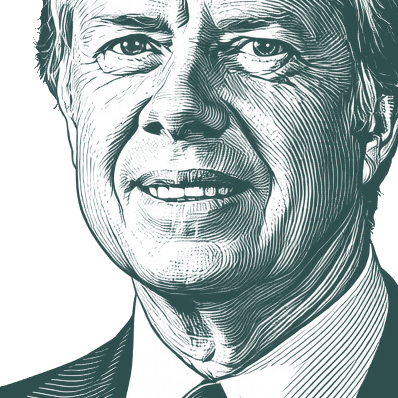
More than any other nation, the United States has been almost constantly involved in armed conflict and, through military alliances, has used war as … - Jimmy Carter
""
More than any other nation, the United States has been almost constantly involved in armed conflict and, through military alliances, has used war as a means of resolving international and local disputes. Since the birth of the United Nations, we have seen American forces involved in combat in Afghanistan, Bosnia, Cambodia, the Dominican Republic, El Salvador, Greece, Grenada, Haiti, Iraq, Korea, Kosovo, Kuwait, Laos, Lebanon, Libya, Nicaragua, Panama, Serbia, Somalia, and Vietnam, and more recently with lethal attacks in Pakistan, Somalia, Yemen, and other sovereign nations. There were no “boots on the ground” in some of these countries; instead we have used high-altitude bombers or remote-control drones. In these cases we rarely acknowledge the tremendous loss of life and prolonged suffering among people in the combat zones, even after our involvement in the conflict is ended.
English
Collect this quote
About
Jimmy Carter
James Earl Carter, Jr. (October 1, 1924 – December 29, 2024) was an American politician and member of the Democratic Party who served as the 39th president of the United States from 1977 to 1981. In 1982 he established the Carter Center, as a base for promoting human rights, democracy, finding peaceful solutions to international conflicts, and advancing economic and social development, for which he was awarded the Nobel Peace Prize in 2002. He was a key figure in the Habitat for Humanity project, and has been noted for his criticism of Israel's role in the Israeli–Palestinian conflict.
Biography information from
Wikiquote·
Portrait adapted from
Wikimedia Commons, Department of Defense. Department of the Navy. Naval Photographic Center (Public domain / CC0)
Also Known As
Birth Name:
James Earl Carter Jr.
Alternative Names:
James E. Carter
•
James Carter
•
James Earl Carter
•
39th President of the United States
•
James E. Carter Jr.
•
James Earl Carter, Jr.
•
James E. Carter, Jr.
A strong nation, like a strong person, can afford to be gentle, firm, thoughtful, and restrained. It can afford to extend a helping hand to others. It is a weak nation, like a weak person, that must behave with bluster and boasting and rashness and other signs of insecurity.
I made the decision myself to contact the Soviets. We told them that we were aware of the problem, asked them for any information about the satellite, and told them unofficially that we would not try to capitalize on their misfortune in a propaganda way. We wanted to be sure that the adequate preparation was made for the reentry of the satellite into the atmosphere, and we notified some of our key allies around the world who would have the capability both to monitor the progress of the satellite and also to deal with radioactivity once it fell. I had a difficult decision to make in how much publicity to bring to this satellite, because it's almost impossible to let people know the facts without the threat being exaggerated, and we didn't want to create exaggerated fears. We monitored the satellite constantly. We shared with the Soviets estimates of when it would come down. the exact point of its penetration of the atmosphere was not known until just an hour or two before it crashed, because it was tumbling. And when a satellite of that kind enters the atmosphere, it can skip off and go several thousands of miles further than you have actually anticipated. We knew that it would fall somewhere between just north of Hawaii, northeast of Hawaii, or the eastern side of Africa. And it was making a great circle route up above the point where it finally fell. That was just about the northern point. The Soviets did tell us, in general, what kind of reactor it was. They told us that their best estimate was it would burn as it entered the atmosphere. So, I can't—without going back and checking the exact language of their report to us—I can't say whether they gave us all the facts. But I think it was handled properly; certainly, by us. I don't know who else the Soviets notified. When I found that it was going to hit Canada, early that morning—I come over here quite early in the morning—I called the Prime Minister of Canada and talked to him on the phone. And we were pretty lucky in telling him where it was going into the atmosphere. We had it on radar. But in retrospect, it may be that the Soviets could have given us more information. I think they probably gave us about what we would have given them in a similar circumstance.
Iraq is an unjust war. I thought then, and I think now, that the invasion of Iraq was unnecessary and unjust. And I think the premises on which it was launched were false.