This is the truth of the matter. In every human being there is a capacity, the capacity for knowledge. And every person - the most knowing and the mo… - Søren Kierkegaard
""
This is the truth of the matter. In every human being there is a capacity, the capacity for knowledge. And every person - the most knowing and the most limited - is in his knowledge far beyond what he is in his life or what his life expresses. Yet this misrelation is of little concern to us. On the contrary, we set a high price on knowledge, and everyone strives for this knowledge more and more. "But," says the sensible person, "one must be careful about the direction one's knowing takes. If my knowing turns inward, against me, if I do not take care to prevent this, then knowing is the most intoxicating thing there is, the way to become completely intoxicated, since there then occurs an intoxicating confusion between the knowledge and the knower, so that the knower himself will resemble, will be, that which is known. If your knowing takes such a turn and you yield to it, it will soon end with your tumbling like a drunk man into actuality, plunging yourself recklessly into drunken action without giving the understanding and sagacity the time to take into proper consideration what is prudent, what is advantageous, what will pay. This is why we, the sober ones, warn you, not against knowing or against expanding your knowledge, but against letting your knowledge take an inward direction, for then it is intoxicating." This is thieves' jargon. It says that it is one's knowledge that, by taking the inward direction in this way, intoxicates, rather than that in precisely this way it makes manifest that one is intoxicated, intoxicated in one's attachment to this earthly life, the temporal, the secular, and the selfish. And this is what one fears, fears that one's knowing, turned inward, toward oneself, will expose the intoxication there, will expose that one prefers to remain in this state, will wrench one out of this state and as a result of such a step will make it impossible for one to slip back into that adored state, into intoxication. p. 118
Søren Aabye Kierkegaard (5 May 1813 – 11 November 1855) was a Danish Christian philosopher and theologian, considered to be a founder of Existentialist thought and Absurdist traditions. He wrote critical texts on organized religion, Christendom, morality, ethics, psychology and philosophy of religion, displaying a fondness for metaphor, irony and parables.
Biography information from
Wikiquote·
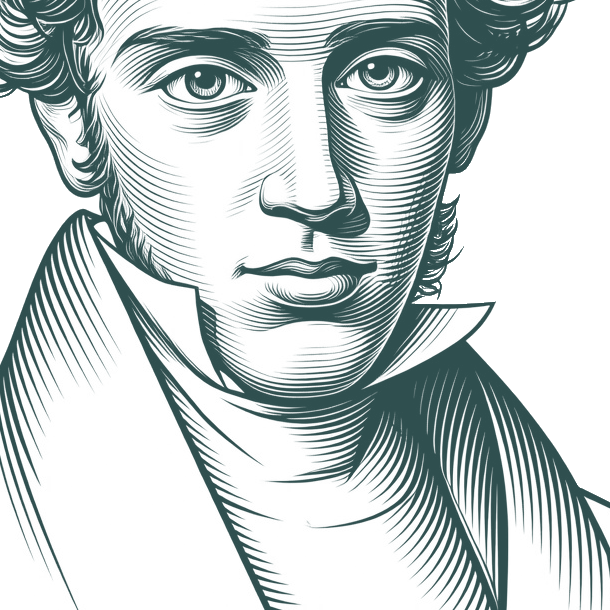
Portrait adapted from
Wikimedia Commons, La Biblioteca Real de Dinamarca (Public domain / CC0)
Also Known As
Pen Names:
Victor Eremita
•
A
•
Judge William
•
Johannes de silentio
•
Constantine Constantius
•
Young Man
•
Vigilius Haufniensis
•
Nicolaus Notabene
•
Hilarius Bookbinder
•
Johannes Climacus
•
Inter et Inter
•
H.H.
•
Anti-Climacus
•
B
•
Johannes de Silentio
•
Constantin Constantius
•
P. CH. Kierkegaard
Native Name:
Søren Aabye Kierkegaard
Alternative Names:
Kierkegaard
•
Climacus
•
Sören Aaby Kierkegaard
Imagine a person who has been and is addicted to a passion. There comes a moment (as it does to everyone, perhaps many times – alas, perhaps many times in vain!), a moment he seems to be brought to a halt: a good resolution is awakening. Imagine that one morning he said to himself (let us suppose him to be a gambler), “I solemnly vow that I will nevermore have anything to do with gambling, never – tonight will be the last time” – ah, my friend, he s lost! I would rather bet on the opposite, however strange that may seem. If there was a gambler who said to himself, “Well, now, you may gamble every blessed day all the rest of your life – but tonight you are going to leave it alone,” and he did – ah, my friend, he is saved for sure! The first gambler's resolution is a trick by the craving, and the second gambler's is to fool the craving.
What if the equality between us human being, in which we completely resemble one another, were that none of us really thinks about his being loved? Preface P. 166
Go Premium
Support Quotewise while enjoying an ad-free experience and premium features.
My soul is so heavy that no longer can any thought sustain it, no wingbeat lift it up into the ether. If it moves, it only sweeps along the ground like the low flight of birds when a thunderstorm is brewing.