Simonson, in rubber jacket and similar galoshes, bound with whip-cord over woolen socks (he was a vegetarian and did not use the skin of animals), wa… - Leo Tolstoy
""
Simonson, in rubber jacket and similar galoshes, bound with whip-cord over woolen socks (he was a vegetarian and did not use the skin of animals), was also awaiting the departure of the party. He stood near the entrance of the house, writing down in a note-book a thought that occurred to him. "If," he wrote, "a bacterium were to observe and analyze the nail of a man, it would declare him an inorganic being. Similarly, from an observation of the earth's surface, we declare it to be inorganic. That is wrong."
English
Collect this quote
About
Leo Tolstoy
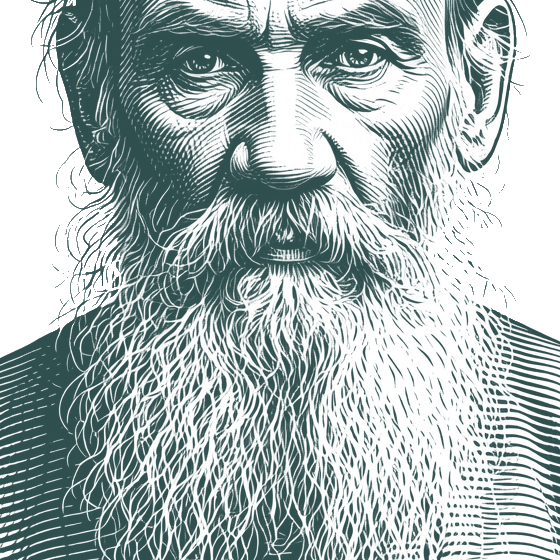
Lev Nikolayevitch Tolstoy [Ле́в Никола́евич Толсто́й, usually rendered Leo Tolstoy, or sometimes Tolstoi] (9 September 1828 – 20 November 1910) was a Russian writer, philosopher and social activist (social critic), whose novels War and Peace and Anna Karenina are internationally praised classics of world literature. He was a major influence on the development of Christian anarchism and pacifism, contributing to such nonviolent resistance movements as those of Mahatma Gandhi, Martin Luther King, Jr., and James Bevel.
Biography information from
Wikiquote·
Portrait adapted from
Wikimedia Commons, Sergei Prokudin-Gorskii (Public domain / CC0)
Also Known As
Pen Names:
Л. Н. Т.
•
Л. Н.
Birth Name:
Lev Nikolayevich Tolstoy
Native Name:
Лев Никола́евич Толсто́й
Alternative Names:
Count Lev Nikolayevich Tolstoy
•
Tolstoy, Leo, graf, 1828-1910
•
Tolstoĭ, Lev Nikolaevich, graf, 1828-1910
•
Lev Nikolayevich Tolstoĭ
•
Leo Tolstoi
•
Tolstoĭ, Lev Nikolaevich, graf
•
Tolstoy, Leo, graf
War is not a polite recreation, but the vilest thing in life, and we ought to realize this and not make a game of it... as it stands now it's the favorite pastime of the idle and frivolous.
Every reform by violence is to be deprecated, because it does little to correct the evil while men remain as they are, and because wisdom has no need of violence.
Works in ChatGPT, Claude, or Any AI
Add semantic quote search to your AI assistant via MCP. One command setup.