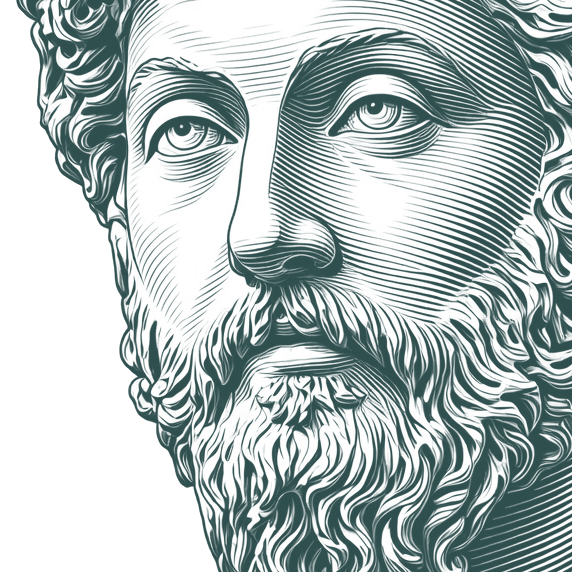
The things... which are proper to the understanding no other man is used to impede, for neither fire, nor iron, nor tyrant, nor abuse, touches it in … - Marcus Aurelius
""
The things... which are proper to the understanding no other man is used to impede, for neither fire, nor iron, nor tyrant, nor abuse, touches it in any way. When it has been made a sphere, it continues a sphere.
Marcus Aurelius Antoninus (26 April 121 – 17 March 180) was Roman emperor from 161 to 180 and a Stoic philosopher. He was the last of the rulers known as the Five Good Emperors (a term coined some 13 centuries later by Niccolò Machiavelli), and the last emperor of the Pax Romana (27 BC to 180), an age of relative peace and stability for the Roman Empire. He served as Roman consul in 140, 145, and 161.
Portrait adapted from
Wikimedia Commons, Marie-Lan Nguyen (2011) (CC BY)
Also Known As
Native Name:
Marcus Aurelius Antoninus
Alternative Names:
Caesar Marcus Aurelius Antoninus Augustus
•
Marcus Annius Verus
•
Marcus Catilius Severus Annius Verus
•
Verissimus
•
Marcus Aurelius Verus
•
Antoninus
What is not good for the swarm is not good for the bee.
An angry countenance is much against nature, and it is oftentimes the proper countenance of them that are at the point of death. But were it so, that all anger and passion were so thoroughly quenched in thee, that it were altogether impossible to kindle it any more, yet herein must not thou rest satisfied, but further endeavour by good consequence of true ratiocination, perfectly to conceive and understand, that all anger and passion is against reason.
The universal intelligence puts itself in motion for every separate effect... or it puts itself in motion once, and everything else comes by way of a sequence in a manner; or individual elements are the origin of all things. In a word, if there is a god, all is well; and if chance rules, do not thou be governed by it.