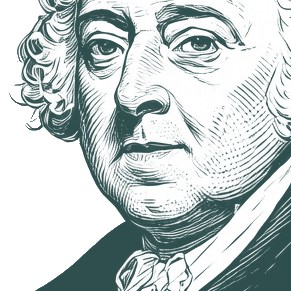
A desire to be observed, considered, esteemed, praised, beloved, and admired by his fellows is one of the earliest, as well as the keenest dispositio… - John Adams
""
A desire to be observed, considered, esteemed, praised, beloved, and admired by his fellows is one of the earliest, as well as the keenest dispositions discovered in the heart of man.
John Adams (30 October 1735 – 4 July 1826) was an American lawyer, author, statesman, and diplomat. He served as the second president of the United States (1797–1801), the first vice president (1789–1797), and as a Founding Father was a leader of American independence from the British Empire. Adams was a political theorist in the Age of Enlightenment who promoted republicanism and a strong central government. His innovative ideas were frequently published. He was also a dedicated diarist and correspondent, particularly with his wife and key advisor Abigail. He was the father of John Quincy Adams.
Biography information from
Wikiquote·
Portrait adapted from
Wikimedia Commons, Gilbert Stuart (Public domain / CC0)
All the perplexities, confusion, and distress in America arise, not from want of honor or virtue, but from the downright ignorance of the nature of coin, credit, and circulation.
What a fine affair it would be if we could flit across the Atlantic as they say the angels do from planet to planet.
Unlimited Quote Collections
Organize your favorite quotes without limits. Create themed collections for every occasion with Premium.
As to the history of the revolution, my ideas may be peculiar, perhaps singular. What do we mean by the Revolution? The war? That was no part of the revolution; it was only an effect and consequence of it. The revolution was in the minds of the people, and this was effected from 1760–1775, in the course of fifteen years, before a drop of blood was shed at Lexington.