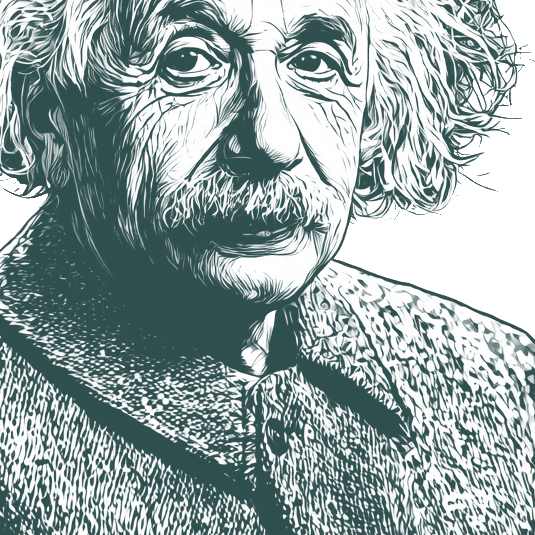
Each of us is here for a brief sojourn, for what purpose he knows not, though sometimes he thinks he feels it - Albert Einstein

" "

Each of us is here for a brief sojourn, for what purpose he knows not, though sometimes he thinks he feels it

English
Collect this quote

About Albert Einstein

Albert Einstein (14 March 1879 – 18 April 1955) was a German theoretical physicist, widely acknowledged to be one of the greatest physicists of all time. Einstein is known for developing the theory of relativity, but he also made important contributions to the development of the theory of quantum mechanics. Together, relativity and quantum mechanics are the two pillars of modern physics. He won the 1921 Nobel Prize in Physics for his explanation of the photoelectric effect.

Biography information from Wikiquote

Also Known As

Alternative Names: A.Einsten A. Einstein Einstein
Enhance Your Quote Experience

Enjoy ad-free browsing, unlimited collections, and advanced search features with Premium.

Related quotes. More quotes will automatically load as you scroll down, or you can use the load more buttons.

Additional quotes by Albert Einstein

The tendencies we have mentioned are something new for America. They arose when, under the influence of the two World Wars and the consequent concentration of all forces on a military goal, a predominantly military mentality developed, which with the almost sudden victory became even more accentuated. The characteristic feature of this mentality is that people place the importance of what Bertrand Russell so tellingly terms “naked power” far above all other factors which affect the relations between peoples. The Germans, misled by Bismarck’s successes in particular, underwent just such a transformation of their mentality — in consequence of which they were entirely ruined in less than a hundred years. I must frankly confess that the foreign policy of the United States since the termination of hostilities has reminded me, sometimes irresistibly, of the attitude of Germany under Kaiser Wilhelm II, and I know that, independent of me, this analogy has most painfully occurred to others as well. It is characteristic of the military mentality that non-human factors (atom bombs, strategic bases, weapons of all sorts, the possession of raw materials, etc.) are held essential, while the human being, his desires and thoughts — in short, the psychological factors — are considered as unimportant and secondary. Herein lies a certain resemblance to Marxism, at least insofar as its theoretical side alone is kept in view. The individual is degraded to a mere instrument; he becomes “human materiel.” The normal ends of human aspiration vanish with such a viewpoint. Instead, the military mentality raises “naked power” as a goal in itself — one of the strangest illusions to which men can succumb.

Science is a wonderful thing if one does not have to earn one's living at it.

I believe in Spinoza's God, who reveals Himself in the lawful harmony of the world, not in a God who concerns Himself with the fate and the doings of mankind...

to Rabbi Herbert Goldstein (1929)

Loading...