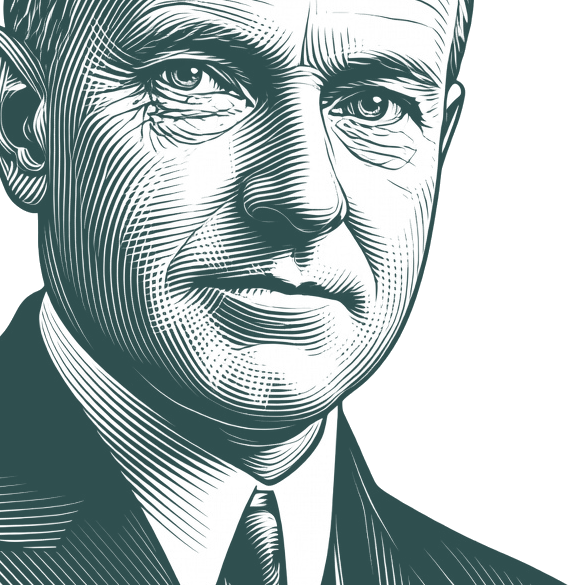
There does not seem to be cause for alarm in the dual relationship of the press to the public, whereby it is on one side a purveyor of information an… - Calvin Coolidge
""
There does not seem to be cause for alarm in the dual relationship of the press to the public, whereby it is on one side a purveyor of information and opinion and on the other side a purely business enterprise. Rather, it is probable that a press which maintains an intimate touch with the business currents of the nation, is likely to be more reliable than it would be if it were a stranger to these influences. After all, the chief business of the American people is business. They are profoundly concerned with producing, buying, selling, investing and prospering in the world. I am strongly of opinion that the great majority of people will always find these are moving impulses of our life. The opposite view was oracularly and poetically set forth in those lines of Goldsmith which everybody repeats, but few really believe: 'Ill fares the land, to hastening ills a prey, Where wealth accumulates, and men decay.'.
English
Collect this quote
About
Calvin Coolidge
John Calvin Coolidge Jr. (4 July 1872 – 5 January 1933) was the 30th president of the United States (1923–29). A Republican lawyer from Vermont, Coolidge worked his way up the ladder of Massachusetts state politics, eventually becoming governor of that state. His response to the Boston Police Strike of 1919 thrust him into the national spotlight and gave him a reputation as a man of decisive action. Soon after, he was elected as the 29th vice president in 1920 and succeeded to the presidency upon the sudden death of Warren G. Harding in 1923. Elected in his own right in 1924, he gained a reputation as a small-government conservative.
Biography information from
Wikiquote·
Portrait adapted from
Wikimedia Commons, Harris & Ewing (Public domain / CC0)
Also Known As
Birth Name:
John Calvin
Alternative Names:
John Calvin Coolidge Jr.
•
John Calvin Coolidge
•
President Coolidge
•
J. C. Coolidge
•
C. Coolidge
•
Silent Cal
•
Silent Cal Coolidge
Nothing in the world can take the place of persistence. Talent will not; nothing is more common than unsuccessful men with talent. Genius will not; unrewarded genius is almost a proverb. Education will not; the world is full of educated derelicts. Persistence and determination alone are omnipotent. The slogan "press on" has solved and always will solve the problems of the human race.
To my mind, the great strength of your Society lies in its recognition of the necessity of discipline. We live in an impatient age. We demand results, and demand them at once. We find a long and laborious process very irksome, and are constantly seeking for a short cut. But there is no easy method of securing discipline. It is axiomatic that there is no royal road to learning. The effort for discipline must be intensive, and to a considerable degree it must be lifelong. But it is absolutely necessary, if there is to be any self-direction or any self-control. The worst evil that could be inflicted upon the youth of the land would be to leave them without restraint and completely at the mercy of their own uncontrolled inclinations. Under such conditions education would be impossible, and all orderly development intellectually or morally would be hopeless. I do not need to picture the result. We know too well what weakness and depravity follow when the ordinary processes of discipline are neglected.
Works in ChatGPT, Claude, or Any AI
Add semantic quote search to your AI assistant via MCP. One command setup.
It would not be unjust to ask of every alien: What will you contribute to the common good, once you are admitted through the gates of liberty? Our history is full of answers of which we might be justly proud. But of late, the answers have not been so readily or so eloquently given. Our country must cease to be regarded as a dumping ground. Which does not mean that it must deny the value of rich accretions drawn from the right kind of immigration. Any such restriction, except as a necessary and momentary expediency, would assuredly paralyze our national vitality. But measured practically, it would be suicidal for us to let down the bars for the inflowing of cheap manhood, just as, commercially, it would be unsound for this country to allow her markets to be overflooded with cheap goods, the product of a cheap labor. There is no room either for the cheap man or the cheap goods.