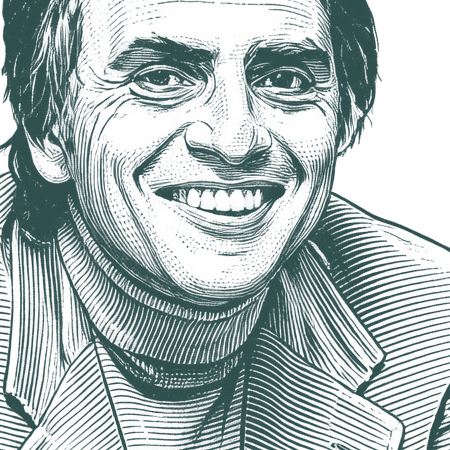
Carl Edward Sagan (9 November 1934 – 20 December 1996) was an American astronomer, planetary scientist, cosmologist, astrophysicist, astrobiologist, author, and science communicator. His best known scientific contribution is research on extraterrestrial life, including experimental demonstration of the production of amino acids from basic chemicals by radiation. Sagan assembled the first physical messages sent into space, the Pioneer plaque and the Voyager Golden Record, universal messages that could potentially be understood by any extraterrestrial intelligence that might find them. Sagan argued the hypothesis, accepted since, that the high surface temperatures of Venus can be attributed to, and calculated using, the greenhouse effect. He testified to the US Congress in 1985 that the greenhouse effect will change the earth's climate system.
Biography information from
Wikiquote·
Portrait adapted from
Wikimedia Commons, NASA/JPL (Public domain / CC0)
Also Known As
Native Name:
Carl Edward Sagan
Alternative Names:
Sagan
•
Carl E. Sagan
•
Carl E Sagan
•
C. E. Sagan
•
C.E. Sagan
•
C E Sagan
•
C. Sagan
•
C Sagan
•
Sagan C
•
Sagan C.
•
Sagan C. E.
•
Sagan CE
Some UFOlogists consider it a telling point that women who claim to have been sexually inactive wind up pregnant, and attribute their state to alien impregnation. A goodly number appear to be teenagers. Taking their stories at face value is not the only option available to the serious investigator. Surely we can understand why, in the anguish of an unwanted pregnancy, a teenager living in a society flooded with accounts of alien visitation might invent such a story. Here, too, there are possible religious antecedents.
In the face of all this, many of the standard ideas of science fiction seem to me to pale by comparison. I see the relative absence of these things and the distortions of scientific thinking often encountered in science fiction as terrible wasted opportunities. Real science is as amenable to exciting and engrossing fiction as fake science, and I think it is important to exploit every opportunity to convey scientific ideas in a civilization which is both based upon science and does almost nothing to ensure that science is understood.
The rabbit was not domesticated until early medieval times (it was bred by French monks in the belief that newborn bunnies were fish and therefore exempt from the prohibitions against eating meat on certain days in the Church calendar);