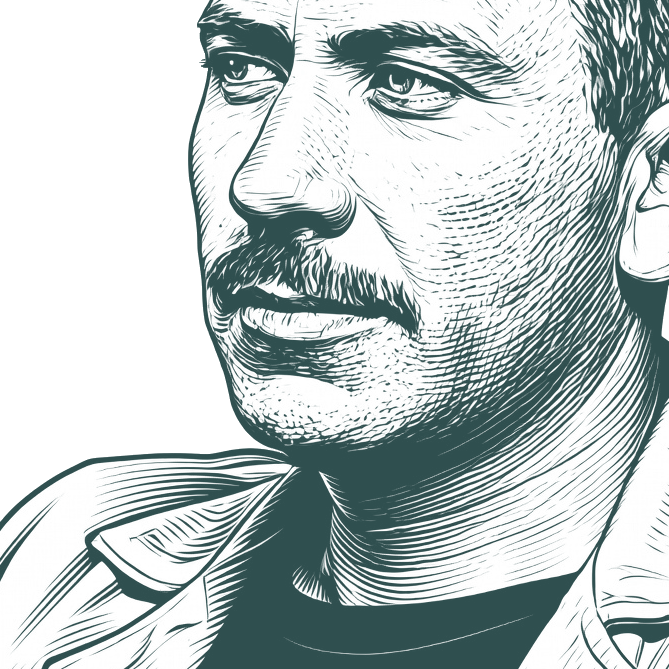
But you can't start. Only a baby can start. You and me - why, we're all that's been. The anger of a moment, the thousand pictures, that's us. This la… - John Steinbeck
""
But you can't start. Only a baby can start. You and me - why, we're all that's been. The anger of a moment, the thousand pictures, that's us. This land, this red land, is us; and the flood years and the dust years and the drought years are us. We can't start again.
John Ernst Steinbeck Jr. (27 February 1902 – 20 December 1968) was an American writer. A recipient of the Nobel Prize for Literature in 1962, his works include the novella Of Mice and Men (1937) and the novel The Grapes of Wrath (1939, Pulitzer Prize for Fiction, 1940), both of which examine the lives of the working class and migrant workers during the Great Depression.
Biography information from
Wikiquote·
Portrait adapted from
Wikimedia Commons, McFadden Publications, Inc.; no photographer credited; photo likely the work of Sonya Noskowiak, as Steinbeck is wearing the same clothes from her 1935 studio session that produced the work shown here: https://www.si.edu/object/npg_NPG.2006.74 (Public domain / CC0)
Also Known As
Birth Name:
Jeffery Ernest Steinbeck
Alternative Names:
John Ernst Steinbeck, Jr.
•
John Ernst Steinbeck
•
John Ernest Steinbeck
•
John Ernst Steinbeck Jr
•
Steinbeck
Portrait from Wikimedia Commons. Credit: McFadden Publications, Inc.; no photographer credited; photo likely the work of Sonya Noskowiak, as Steinbeck is wearing the same clothes from her 1935 studio session that produced the work shown here: https://www.si.edu/object/npg_NPG.2006.74. Used under Public domain / CC0. Processed and styled by Quotewise.
Works in ChatGPT, Claude, or Any AI
Add semantic quote search to your AI assistant via MCP. One command setup.
If every single man and woman, child and baby, acts and conducts itself in a known pattern and breaks no walls and differs with no one and experiments in no way and is not sick and does not endanger the ease and peace of mind or steady unbroken flow of the town, then that unit can disappear and never be heard of.
After the bare requisites to living and reproducing, man wants most to leave some record of himself, a proof, perhaps, that he has really existed. He leaves his proof on wood, on stone or on the lives of other people.