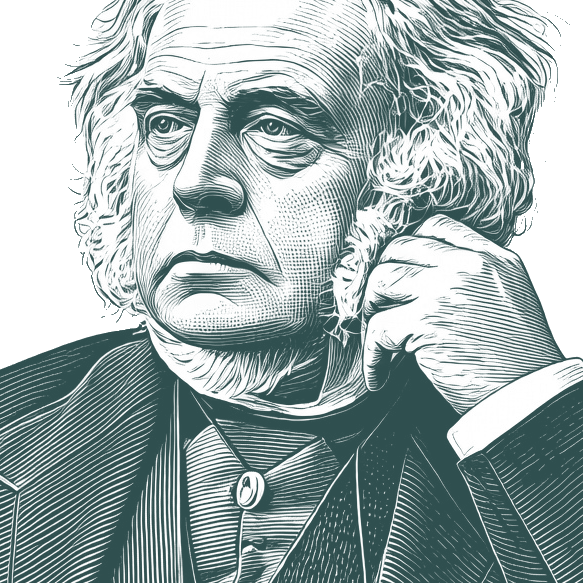
I have often compared, in my own mind, the people of England with the people of ancient Egypt, and the Foreign Office of this country with the temple… - John Bright
""
I have often compared, in my own mind, the people of England with the people of ancient Egypt, and the Foreign Office of this country with the temples of the Egyptians. We are told by those who pass up and down the Nile that on its banks are grand temples with stately statues and massive and lofty columns, statues each one of which would have appeared almost to have exhausted a quarry in its production. You have, further, vast chambers and gloomy passages; and some innermost recess, some holy of holies, in which, when you arrive at it, you find some loathsome reptile which a nation reverenced and revered, and bowed itself down to worship. In our Foreign Office we have no massive columns; we have no statues; but we have a mystery as profound; and in the innermost recesses of it we find some miserable intrigue, in defence of which your fleets are traversing every ocean, your armies are perishing in every clime, and the precious blood of our country's children is squandered as though it had no price. I hope that an improved representation will change all this; that the great portion of our expenditure which is incurred in carrying out the secret and irresponsible doings of our Foreign Office will be placed directly under the free control of a Parliament elected by the great body of the people of the United Kingdom.
John Bright (November 16, 1811 – March 27, 1889) was a British Radical and Liberal statesman, one of the greatest orators of his generation and a promoter of free trade policies.
The question at issue in the late debate was mainly this: Shall the Foreign Minister of this country be permitted to interfere in the affairs of other countries in cases where the direct interests of this country do not require it? Shall he advise, and warn, and meddle in matters which concern only the domestic and internal affairs of other countries? I say that such a policy necessarily leads to irritation, and to quarrels with other nations, and may lead even to war; and that it involves the necessity of maintaining greater armaments, and a heavier expenditure and taxation than would otherwise be required. It is a policy, therefore, which I cannot support under any pretence whatever.
[The opposition to the Reform Bill of 1866 was directed] against the admission of any portion of the working men to the suffrage. The Tory party, and those from the Liberal ranks who join it, are animated by an unchangeable hostility to any Bill which gives the franchise to the working men. They object to any transfer of power from those who now possess it, and they object to share their power with any increased number of their countrymen who form the working class. They regard the workmen here as the southern planter regards the negroes who were so lately his slaves. They can no longer be bought or sold; so far they are free men. They may work and pay taxes; but they must not vote. They must obey the laws, but must have no share in selecting the men who are to make them. The future position of the millions of working men in the United Kingdom is now determined, if the opposition of the Tory party is to prevail—it is precisely that fixed by the southern planter for the negro. Millions of workmen will bear this in mind; they will now know the point or the gulf which separates one party from the other in the House of Commons.
Since I have taken a part in public affairs, the fact of the vast weight of the poverty and ignorance that exists at the bottom of the social scale has been a burden on my mind, and is so now. I have always hoped that the policy which I have advocated, and has been accepted in principle, will tend gradually but greatly to relieve the pauperism and the suffering which we still see among the working classes of society.