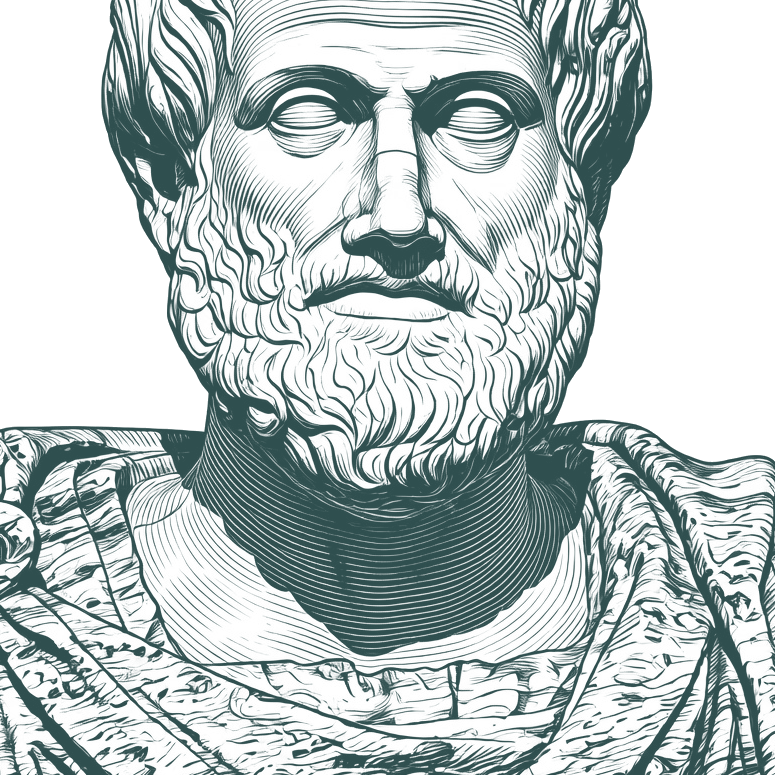
The physician and the philosopher have different ways of defining the diseases of the soul. For instance anger for the philosopher is a sentiment bor… - Aristotle
""
The physician and the philosopher have different ways of defining the diseases of the soul. For instance anger for the philosopher is a sentiment born of the desire to return an offense, whereas for the physician it is a surging of blood around the heart.
English
Collect this quote
About
Aristotle
Aristotle (Ἀριστοτέλης Aristotelēs; 384 BC – 322 BC) was a Greek philosopher and polymath during the Classical period in Ancient Greece. Taught by Plato, he was the teacher of Theophrastus and founder of the Lyceum, the Peripatetic school of philosophy, and the Aristotelian tradition. His writings cover many subjects including physics, biology, zoology, metaphysics, logic, ethics, aesthetics, poetry, theatre, music, rhetoric, psychology, linguistics, economics, politics, meteorology, geology and government. Aristotle provided a complex synthesis of the various philosophies existing prior to him. It was above all from his teachings that the West inherited its intellectual lexicon, as well as problems and methods of inquiry. As a result, his philosophy has exerted a unique influence on almost every form of knowledge in the West and it continues to be a subject of contemporary philosophical discussion.
Biography information from
Wikiquote·
Portrait adapted from
Wikimedia Commons, After Lysippos (Public domain / CC0)
Also Known As
Native Name:
Ἀριστοτέλης
Alternative Names:
the Stagirite
•
Aristotelis
•
Aristoteles
We must not listen to those who advise us 'being men to think human thoughts, and being mortal to think mortal thoughts' but must put on immortality as much as possible and strain every nerve to live according to that best part of us, which, being small in bulk, yet much more in its power and honour surpasses all else.
And further, observing that all this indeterminate substance is in motion, and that no true predication can be made of that which changes, they supposed that it is impossible to make any true statement about that which is in all ways and entirely changeable. For it was from this supposition that there blossomed forth the most extreme view of those which we have mentioned, that of the professed followers of Heraclitus, and such as Cratylus held, who ended by thinking that one need not say anything, and only moved his finger; and who criticized Heraclitus for saying that one cannot enter the same river twice, for he himself held that it cannot be done even once.