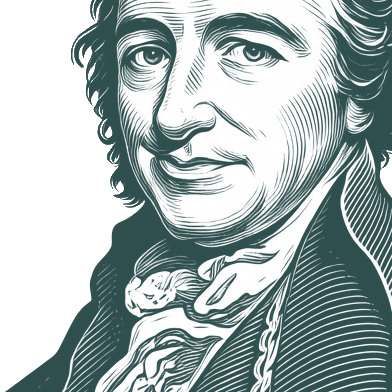
Thomas Paine (February 9, 1737 [O.S. January 29, 1736] – 8 June 1809) was a British-American political writer, theorist, and activist who had a great influence on the thoughts and ideas which led to the American Revolution and the United States Declaration of Independence. He wrote three of the most influential and controversial works of the 18th Century: Common Sense, Rights of Man, and The Age of Reason. His ideas reflected Enlightenment-era ideals of transnational human rights.
Biography information from
Wikiquote·
Portrait adapted from
Wikimedia Commons, Auguste Millière / After George Romney / After William Sharp (Public domain / CC0)
Portrait from Wikimedia Commons. Credit: Auguste Millière / After George Romney / After William Sharp. Used under Public domain / CC0. Processed and styled by Quotewise.
Try QuoteGPT
Chat naturally about what you need. Each answer links back to real quotes with citations.
Related quotes. More quotes will automatically load as you scroll down, or you can use the load more buttons.
For trade being the consequence of population, men become too much absorbed thereby to attend to anything else. Commerce diminishes the spirit, both of patriotism and military defence.
Ignorance is of a peculiar nature: once dispelled, it is impossible to re-establish it. It is not originally a thing of itself, but is only the absence of knowledge; and though man may be kept ignorant, he cannot be made ignorant.
Limited Time Offer
Premium members can get their quote collection automatically imported into their Quotewise collections.
The right of voting for persons charged with the execution of the laws that govern society is inherent in the word liberty, and constitutes the equality of personal rights. But even if that right (of voting) were inherent in property, which I deny, the right of suffrage would still belong to all equally, because, as I have said, all individuals have legitimate birthrights in a certain species of property. -Agrarian Justice