The last hundred years has seen a general decline in the democratic idea. If there be anybody left to whom this historical truth appears a paradox, i… - G. K. Chesterton
""
The last hundred years has seen a general decline in the democratic idea. If there be anybody left to whom this historical truth appears a paradox, it is only because during that period nobody has been taught history, least of all the history of ideas. If a sort of intellectual inquisition had been established, for the definition and differentiation of heresies, it would have been found that the original republican orthodoxy had suffered more and more from secessions, schisms, and backslidings. The highest point of democratic idealism and conviction was towards the end of the eighteenth century, when the American Republic was 'dedicated to the proposition that all men are equal.' It was then that the largest number of men had the most serious sort of conviction that the political problem could be solved by the vote of peoples instead of the arbitrary power of princes and privileged orders.
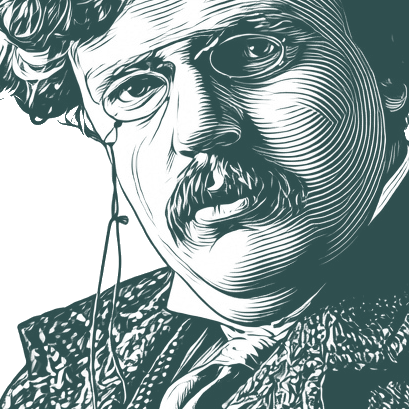
Gilbert Keith Chesterton (29 May 1874 – 14 June 1936) was a British writer whose prolific and diverse output included works of philosophy, ontology, poetry, play writing, journalism, public lecturing and debating, literary and art criticism, biography, Christian apologetics (particularly for Catholicism), and fiction, including fantasy and detective fiction. He has been called the "prince of paradox".
Biography information from
Wikiquote·
Portrait adapted from
Wikimedia Commons, Ernest Herbert Mills (Public domain / CC0)
Also Known As
Native Name:
Gilbert Keith Chesterton
Alternative Names:
František Kafka
•
Kafka
•
Gilbert K. Chesterton
•
Gilbert Chesterton
•
G.K. Chesterton
•
G. K. C.
Like every book I never wrote, it is by far the best book I have ever written.
"If we are calm," replied the policeman, "it is the calm of organized resistance." "Eh?" said Syme, staring. "The soldier must be calm in the thick of the battle," pursued the policeman. "The composure of an army is the anger of a nation."
Works in ChatGPT, Claude, or Any AI
Add semantic quote search to your AI assistant via MCP. One command setup.